
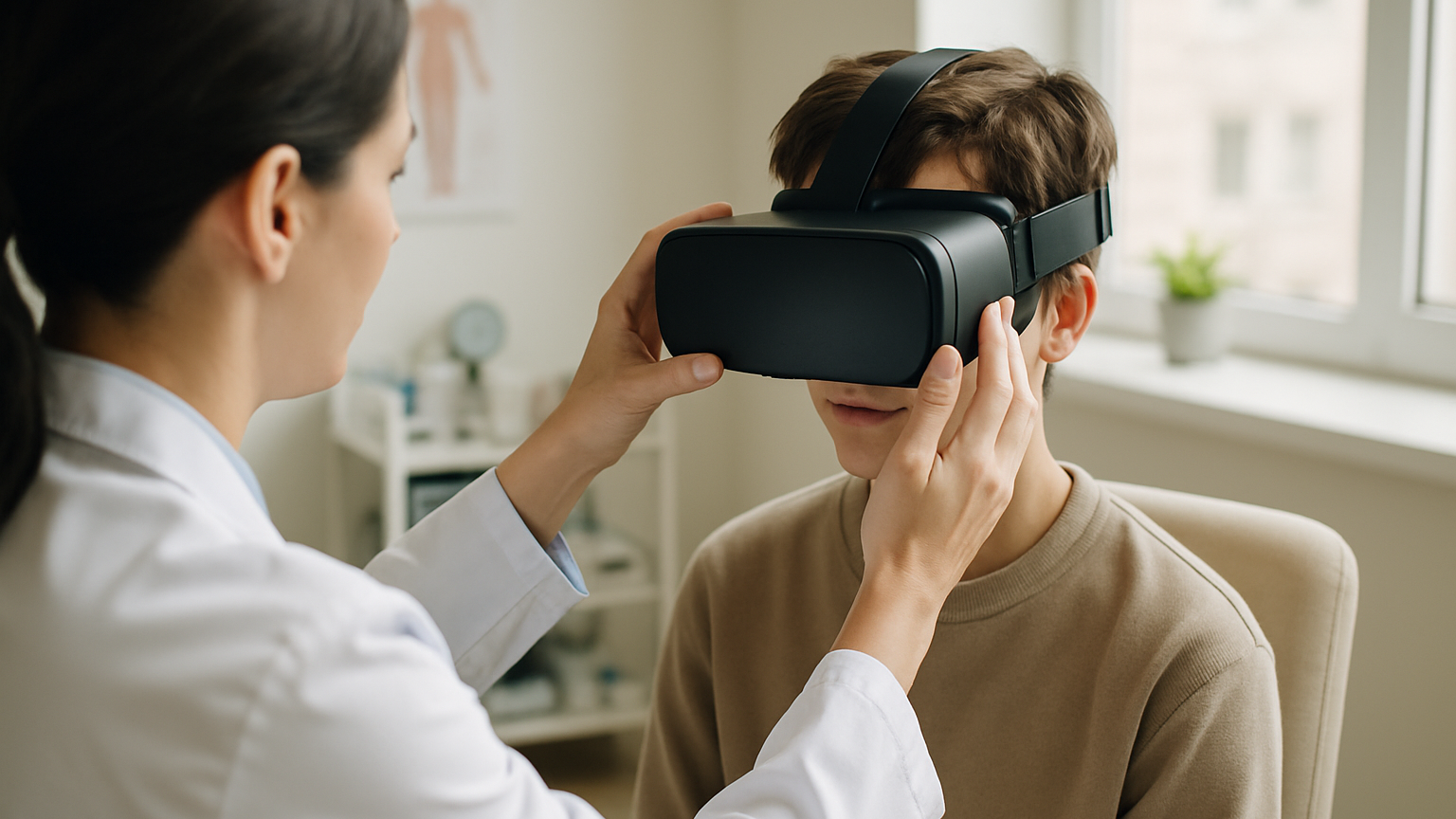
Clinics are under pressure to deliver measurable gains for patients while keeping workflows realistic for teams. That’s exactly where virtual reality steps in: not as a replacement for therapy, but as a focused training environment that’s repeatable, observable and designed to fit inside a therapist-guided session. In other words, VR becomes the place where attention, inhibition, working memory and self-regulation can be practiced with clear goals. The promise isn’t a flashy novelty; it’s structure and control. And when you combine structure with engagement, outcomes follow more reliably.
If you’re weighing ROI, you’re not only asking “does it work?” but also “will our team actually use it, week after week?” The answer lives in the details: repeatable tasks, therapist oversight, progress insights and an implementation plan that respects clinical reality. In this article we look at the clinical logic of VR for ADHD, what structured platforms bring to daily practice, how programs track outcomes, and how to roll out without disrupting your team. No fluff—just what works in clinics.
Why VR For ADHD Works In Clinical Practice
Immersive environments do one thing exceptionally well: they reduce ambiguity. VR attention training for ADHD places a person in a controlled setting where stimuli can be introduced or dialed down on purpose, so attention and response inhibition are not left to chance. Because exercises are repeatable, you can run the same scenario multiple times while adjusting difficulty and distractions. That lets therapists shape attention, working memory and regulation step by step, rather than hoping general advice transfers into daily life.
Think of a 20-minute block where a young person practices staying on task while a controlled set of distractions appears in the periphery. The therapist decides when to pause, when to escalate, and when to insert a grounding task. Breathing and regulation can be guided inside the same environment, so a session flows from arousal downshift to task focus without jumping tools or rooms. That continuity matters; it turns skill drills into a coherent training arc.
Another reason it works: therapist guidance is built into the model, not added as an afterthought. The most meaningful gains come when specialists map ADHD-related needs, choose training goals, and steer the session in real time. VR then becomes an observational window too — you see how someone handles a task-switch, what triggers a lapse, and which self-regulation prompt helps them re-engage.
For whom is this not a fit? If you want a hands-off, unsupervised game that “fixes attention” at home, you’ll be disappointed. The clinical value depends on therapist-guided sessions, structured exercises and gradual progression. Also, if a person has strong VR intolerance or severe sensory overload that prevents brief exposure even in controlled, low-intensity scenes, you’ll likely need a different route first.
Many clinics also support neurodiverse cohorts where ADHD and autism co-occur. In those pathways, teams often combine attention and regulation practice with experiences tailored to sensory needs. If that’s your context, it’s worth exploring the complementary Harmony VR experience alongside attention-focused training.
Inside Focus VR: Therapist-Guided, Structured Training
Focus VR is a virtual reality platform designed to support ADHD-related challenges with structured, engaging and therapist-guided sessions. It centers on attention, inhibition, working memory and self-regulation — delivered through clear, repeatable exercises that can be adjusted to individual needs. If you want the detailed overview of modules and session flow, visit the Focus VR platform page.
Session planning is built in: you map ADHD-related needs, set training goals, choose difficulty, and run a therapist-guided flow. That structure supports consistent progression — not random scenes, but purposeful steps. An individual support pathway keeps sessions aligned with the person’s capacity on a given day, which is crucial when attention, arousal and motivation fluctuate.
Self-regulation has a dedicated place in Focus VR. You can introduce guided breathing, grounding tasks and sensory-controlled environments to lower arousal and prepare for cognitive work. Emotional regulation and conscious reaction training then help bridge from calmer states to task engagement. It’s the therapeutic equivalent of setting the stage before you ask for performance.
Cognitive training spans attention and focus exercises, working memory tasks, response inhibition and task-switching activities. Controlled distraction scenarios allow you to raise or reduce complexity while keeping goals specific — stay on task for a defined interval, inhibit an impulse under clear rules, or switch when a cue appears. Because the environment is consistent, gains are easier to observe.
Progress insights close the loop. Session summaries, progress indicators and task completion tracking make it easier to document what happened and spot patterns across weeks. Specialist observation support is baked in, and the data structure helps with pilots and research without turning every session into a paperwork marathon.
VR attention training for ADHD: Outcomes And ROI
Clinical outcomes start with engagement. Immersive scenes hold attention long enough for real practice to happen; structured exercises make that practice meaningful. In practice, most therapists notice that when sessions follow a clear arc — regulate, focus, task, recover — the person completes more quality repetitions without feeling overwhelmed. More quality reps, more learning.
For clinicians, standardized yet adjustable protocols reduce session prep and give you comparable data points across time. The combination of observation in VR and progress indicators supports better notes and clearer communication with families or multidisciplinary teams. When everyone sees the same training goals and completion markers, collaboration moves faster.
Program-level ROI shows up in a few places: stronger adherence to therapy plans because sessions feel engaging; differentiation of your service line with a structured, therapist-led digital tool; and better data to underpin partnerships or grant applications. If your definition of ROI is an instant, across-the-board cost cut in week one, this is not your tool. If ROI means higher-quality sessions, clearer documentation and a more compelling program for patients and referrers, you’ll recognize the value quickly.
A simple way to visualize impact is an 8–10 week pilot cohort where attention, inhibition and self-regulation goals are practiced in VR weekly, then reinforced between sessions. You track completion of defined tasks, note how difficulty changes over weeks, and document which regulation prompts help the person re-engage. The outcome is both clinical (observable skill progression) and operational (a repeatable, teachable protocol your team can run).
Implementation Playbook: From Pilot To Full Rollout
Strong adoption starts small and specific. A therapist-guided pilot lets you validate fit, surface workflow friction and build internal champions before you expand. Structure beats enthusiasm here: pick a cohort, define goals, set session templates, and decide upfront how you’ll judge success. That way, scaling becomes a process, not a guess.
Design A Therapist-Guided Pilot
Start with a clear inclusion profile — for example, individuals who can tolerate brief VR exposure and benefit from structured attention and regulation practice. Define 1–2 primary goals per person (e.g., consistent on-task intervals, improved response inhibition) and select specific VR exercises that map directly to those goals. Keep session length predictable, and plan a regulation block before cognitive tasks, especially in early weeks.
Train a small therapist group to run the same protocol, document observations and adjust difficulty in-session. Baseline and exit measures can be practical and behavioral — completion of defined tasks in VR, observed recovery time after distraction, or the number of successful task-switches under a set rule. Keep it simple enough to repeat reliably.
Integrate With Sessions And Workflows
Decide where VR fits in your session template. Many teams open with 3–5 minutes of guided breathing in VR, transition into attention tasks for 10–15 minutes, then debrief and assign a carryover strategy. A small, quiet space helps, and a simple headset handling routine (charge, clean, calibrate) keeps things smooth.
Documentation should mirror your current notes: session goals, tasks completed, difficulty used, therapist observations and the plan for next time. Because progress indicators and task completion are available inside structured platforms, most clinicians find it faster to align notes with what was practiced. If you can’t allocate even a short, consistent slot for setup and teardown, adoption will crawl.
Loop in IT early for device management and basic connectivity, and brief admin staff so scheduling reflects the VR block. The more your workflow treats VR as an integrated tool — not a novelty you ‘add if time allows’ — the more predictable your outcomes and the stronger your ROI.
Measure Engagement, Progress And Outcomes
Pick metrics you can capture every session without burdening your team. Focus VR-style structures make this practical by providing session summaries, progress indicators and task completion tracking. Combine those with therapist notes to tell a coherent story of progression week to week.
- Engagement: sessions attended, time-on-task within VR blocks
- Progress: difficulty levels attempted and completed, task completion rates
- Regulation: use of guided breathing or grounding and recovery to task
- Therapist observations: triggers, effective prompts, carryover strategies
When your dashboard is this concrete, team conversations shift from “it felt better” to “we completed three longer intervals at higher difficulty after a shorter regulation block.” That makes clinical decisions clearer and gives program leads real material for quality improvement or research summaries.
Data, Research And Compliance For Healthcare Teams
Structured platforms support research by design. Session summaries, progress indicators, task completion tracking and specialist observation support create consistent, comparable records across participants. That reduces the friction of moving from anecdote to a pilot dataset your clinical or academic partners can actually analyze.
RTE Lab’s work with multidisciplinary teams and healthcare innovation programs helps translate pilots into credible studies or grant-backed projects. If you’re exploring methods, instrumentation or study design, collaborating with our immersive innovation lab can accelerate the R&D steps without losing the clinical thread.
Compliance-wise, align your pilot with internal privacy, data governance and ethics requirements from day one. Define what is recorded, who accesses it and how you report findings to oversight bodies. Keep pilot data minimal and purposeful, and document your rationale — research teams and ethics boards appreciate clarity more than volume.
Finally, plan for handover: create a standard operating procedure for therapists, an orientation for families where relevant, and a lightweight method for exporting or summarizing progress for reviews. That’s what turns a promising tool into a sustainable part of your service.
Pricing, Funding Options And Next Steps
Budget planning for VR in clinics usually includes three buckets: hardware (headsets and basic accessories), software access for the therapeutic platform, and team time for onboarding and pilot delivery. Add a small line for space setup and hygiene supplies, and you have a realistic view of total cost of adoption. Keep your pilot scope tight so costs stay clear and contained.
Funding often comes from innovation or program development budgets, research partnerships and grants. RTE Lab’s R&D process supports grant-funded projects, which helps align clinical goals with study design and reporting. When your proposal shows structured exercises, therapist guidance and built-in progress insights, reviewers see a pathway from intervention to measurable outcomes.
If your context demands zero therapist time, instant home deployment, or immediate cost savings without a pilot, VR is likely the wrong route. But if you can commit to brief, guided sessions and a simple measurement plan, VR attention training for ADHD can become a durable part of your care model — not an experiment that fades after two months.
Your next step is straightforward: define a pilot cohort, pick two or three training goals, and map them to structured VR exercises with a therapist-guided flow. Run it for 8–10 weeks, track the core metrics, and review outcomes with your team. If the signal is strong, scale with confidence and standardize the workflow across clinicians.