
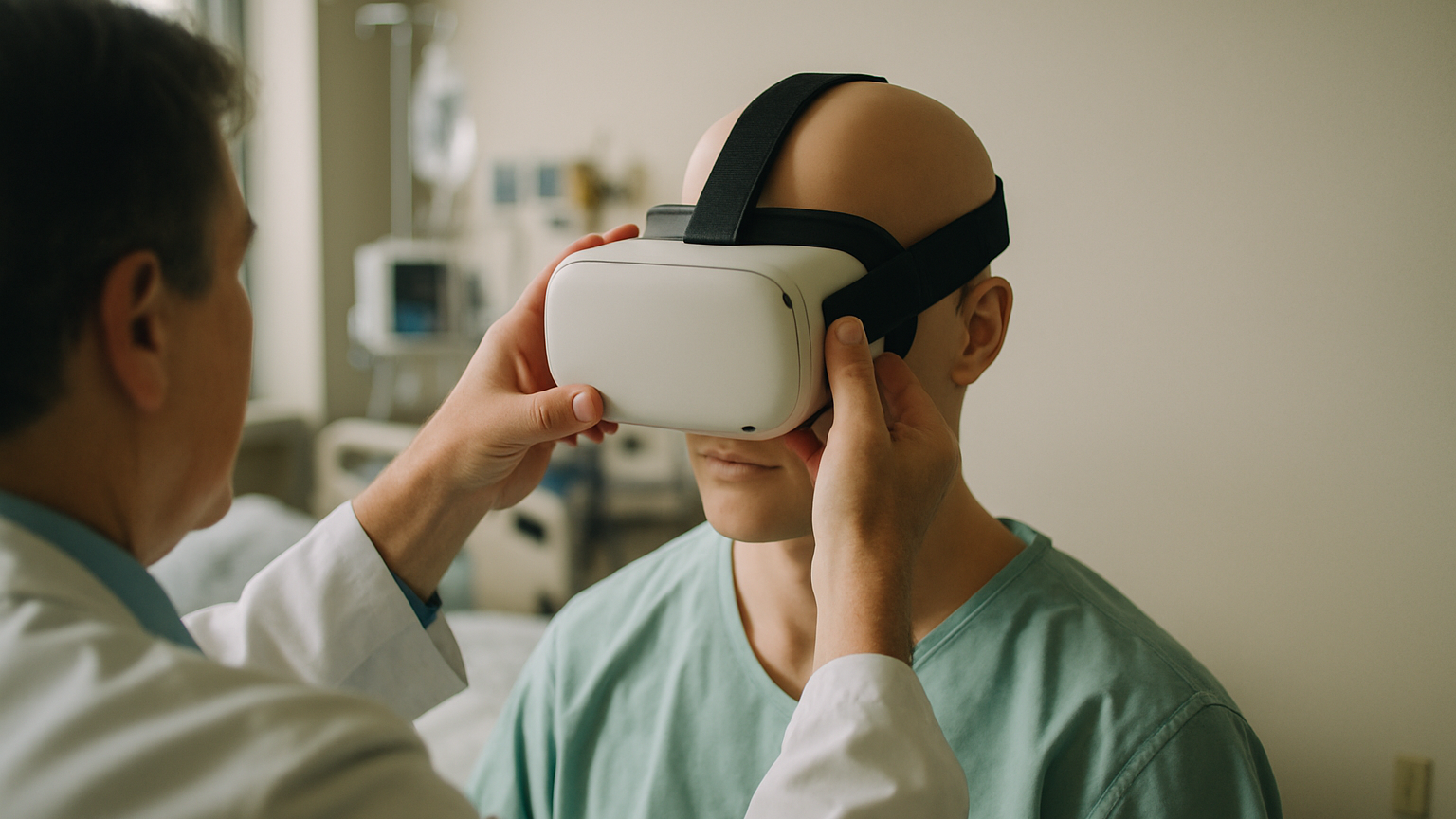
Medical education advances fastest when practice feels real, repeatable and safe. Extended Reality makes that possible; AI turns it into a living, adaptive curriculum. Instead of static scripts, instructors can generate nuanced patient states, branching dialogue, and contextual feedback that reflect how care actually unfolds. That means more deliberate practice, clearer objectives and fewer assumptions about what learners have seen before. Most importantly, it lets teams design, prototype and validate simulations around real user needs—students, clinicians, therapists—rather than around the limits of a tool.
If you teach medicine, nursing, rehab or behavioral health, you know the problem: the hard parts are never just the steps. They’re the judgment calls, the communication under pressure, and the adaptations when a plan meets a patient’s reality. AI scenario authoring for XR training helps encode those messy moments into structured, measurable experiences. It creates controlled yet varied environments where learners can try, err, reflect and try again. And because it’s built for iteration, you can move from idea to pilot, from pilot to validated lesson, without losing sight of outcomes.
Why AI-powered scenario design matters in healthcare education
Healthcare training depends on repeatability and relevance. AI-powered scenario design keeps cases consistent where it matters—protocols, safety steps—while varying what changes learning: patient history, comorbidities, family dynamics, resource constraints. That balance lets you teach the stable core and the adaptive edge at once. In practice, this prevents learners from memorizing a script and nudges them to reason clinically. Over time, the result is fewer rote responses and more calibrated decisions.
Another advantage is speed to relevance. Educators can draft a case aligned to competencies, auto-generate plausible variants, then refine language, vitals and prompts with domain input. Feedback loops shrink from weeks to days because authoring, playtesting and analytics live in the same loop. When we run early-stage builds in our immersive innovation lab, faculty see right away which cues land and which need rephrasing. That momentum keeps projects focused on outcomes, not on tooling overhead.
Finally, AI supports assessment without turning simulations into paperwork. Checklists can be generated from objectives, mapped to observable behaviors, and paired with just-in-time hints or debrief prompts. Voice, gaze and action data can be translated into learning signals—hesitation before a drug order, a missed confirmation question, an incomplete explanation of risk. You stay in control of the rubric, but you gain richer evidence to guide remediation. That’s what makes practice stick.
How AI scenario authoring for XR training translates into measurable skills
Skills become measurable when scenarios are written from outcomes backward. Start with the competency—say, recognizing sepsis risk or conducting informed consent—and define the observable behaviors that prove it. AI scenario authoring for XR training then scaffolds the case: vital signs that drift within plausible ranges, dialogue that tests understanding, branching that exposes frequent errors. Because each element is tied to an outcome, you can log meaningful signals instead of generic completion flags. That clarity helps learners self-correct faster.
Debriefing gets sharper too. Instead of “good job” or “needs work,” you can show a decision timeline, questions asked versus omitted, and how the chosen path compared to safer alternatives. AI-generated debrief notes can suggest targeted practice: rehearse teach-back, verify allergies earlier, or re-check differential when vitals shift. In practice, most faculty start with one or two core cases and expand only after their first debrief cycle. That’s when the gaps—and the wins—become obvious.
Across cohorts, aggregated analytics reveal where learners consistently struggle. Maybe it’s dosage calculations under time pressure, or conveying risk without inducing panic. With structured authoring, you can spin up focused micro-scenarios that target a single behavior and reinsert them into the course flow. Over a term, that iterative loop shifts the signal from anecdote to evidence. And that is the currency that curriculum committees trust.
From idea to validated XR lesson: a practical workflow
Great simulations start with a real educational pain point, not with hardware specs. Gather faculty, clinicians and, where appropriate, patients to surface critical incidents and near-miss patterns. Translate those into explicit objectives and constraints before drafting a single line of dialogue. Only then bring AI into the mix to propose scenario arcs, prompts and plausible data ranges. The result is a first build that already speaks your curriculum’s language.
- Define competencies and observable behaviors; list unacceptable errors upfront.
- Map the environment and roles: where, who, which tools, and what resources are limited.
- Draft the base case; use AI to generate 3–5 realistic variants and common distractors.
- Instrument the scenario with checkpoints, timers and debrief prompts tied to outcomes.
- Playtest with 3–5 learners and one facilitator; capture friction, confusion and timing.
- Refine language, cues and branching; remove dead-ends that don’t teach anything.
- Validate with a small pilot: compare performance against your rubric and adjust.
Keep iteration tight. Short cycles avoid overfitting to a single facilitator or an early group. Use AI to propose clarifying prompts or alternate phrasings when learners stall, and to suggest additional distractors when success rates spike. As your evidence stabilizes, formalize the lesson plan and train additional faculty. That is where AI scenario authoring for XR training pays off: consistency without sameness.
Designing clinical simulations that stick
Sticky simulations focus on decisions, not theatrics. They surface the moment a learner must choose, say it out loud, and live with the downstream effects. They respect cognitive load by pacing cues and by making the critical signal louder than the noise. And they close the loop with debriefs that connect choices to consequences. Sounds neat, but it won’t fly without baseline objectives.
Clinical communication simulations
Communication under pressure is a skill you can design for. Branch dialogue around empathy statements, teach-back, and safety-netting; use AI to vary tone, health literacy and emotional intensity without changing the core facts. Instrument checkpoints like “named the diagnosis,” “verified understanding,” and “offered follow-up plan.” Voice or text captures provide evidence for debrief, while prompts suggest repair moves when the interaction goes off track. No fluff, just outcomes.
For interprofessional practice, add role clarity and handoff moments (SBAR or equivalent). Misalignments often surface there—who confirms allergies, who escalates, who documents. AI can generate plausible interruptions or equipment constraints to test prioritization. Over several runs, learners build a repertoire that transfers to wards and clinics. That’s the point.
Rehabilitation scenarios
Rehab is about graded challenge and precise feedback. In XR, tasks can adapt by range of motion, cadence, balance difficulty or dual-task demands, while AI tracks performance trends across sessions. Scenarios can simulate home environments—stairs, clutter, limited aids—to train safe strategies before discharge. Objective signals like completion time, compensatory movements or rest breaks inform progression rules. Learners see progress, clinicians see evidence, and both know when to dial it up or down.
Importantly, rehab scenarios should expose common setbacks: fatigue days, fear of falling, pain spikes. AI-generated variants let you practice responding to those moments—modifying tasks, reframing goals, or pausing and reassessing. Over time, this builds judgment, not just muscle memory. It’s the difference between repeating reps and training adaptation.
ADHD and autism: structured cognitive training
For neurodevelopmental support, structure is everything. Tools like the Focus VR platform center attention, working memory and inhibitory control through time-bounded tasks, clear rules and progressive difficulty. AI adjusts stimulus timing and complexity based on recent performance, keeping training inside the learner’s zone of proximal development. In practice, small, frequent sessions beat marathon blocks every time. And because data is granular, therapists can spot plateaus early and tweak the plan.
For autism, rhythm and predictability reduce cognitive friction while encouraging engagement. The Harmony VR experience uses music and rhythm-based interaction to scaffold turn-taking, attention shifting and sensory regulation. AI can introduce gentle variability—tempo shifts, visual density, response windows—while preserving a safe structure. This won’t replace clinical therapy or crisis care, and it’s not a fit when immediate, high-intensity intervention is required. But as a supportive practice environment, it helps skills generalize beyond the headset.
Working with universities and clinics: pilots, grants and validation
Effective partnerships start with co-defined outcomes and constraints: curriculum goals, timetable realities, hardware availability, and facilitator bandwidth. Early workshops surface the right cases and the wrong assumptions, which saves months later. Because many projects are grant-funded, build a validation plan into your proposal—objectives, measures, sample, timeline—so reviewers see a straight line from R&D to implementation. Review boards look for the same rigor you expect from learners. Meet them there.
Pilots work best when small and honest. Limit scope to what faculty can actually run, and to what learners can realistically complete within a session. After two weeks, one issue usually comes up: scheduling edges into debrief time. Protect the debrief; it’s where learning consolidates and where your data becomes narrative evidence. Then iterate on timing, instructions and facilitator cues.
When results stabilize, translate them into course artifacts: lesson plans, facilitator guides, rubrics and remediation pathways. That documentation unlocks scale because it makes the experience portable across instructors and cohorts. Collaboration with university and healthcare innovation programs strengthens this step by aligning the work with institutional processes. It also anchors the technology in real educational value rather than novelty.
Implementation at scale: faculty enablement, ethics and data
Scaling is a people project. Faculty need onboarding not only to the headset and controls, but to the scenario logic, the assessment model and the debrief flow. Provide short facilitator run-throughs, common pitfalls and troubleshooting checklists. Build a feedback channel so instructors can flag confusing cues or scoring quirks. Over a semester, these signals guide small updates that keep quality steady.
Ethics and privacy are design inputs, not afterthoughts. Use data minimization, clear consent language and role-based access to performance logs. Separate learning analytics from identity where possible, and define retention windows. AI models that support authoring or adaptive difficulty should be transparent about what they use and what they don’t. Bias reviews matter as much in education as they do in clinical AI.
Finally, be frank about fit. If your program cannot allocate debrief time, or if you need unstructured improvisation without assessment, this approach will frustrate you. AI scenario authoring for XR training shines when outcomes are explicit, practice is repeatable, and feedback loops are embraced. If those foundations are in place, the technology fades into the background and the learning does the talking. That’s when scale feels like quality multiplied, not just content copied.