
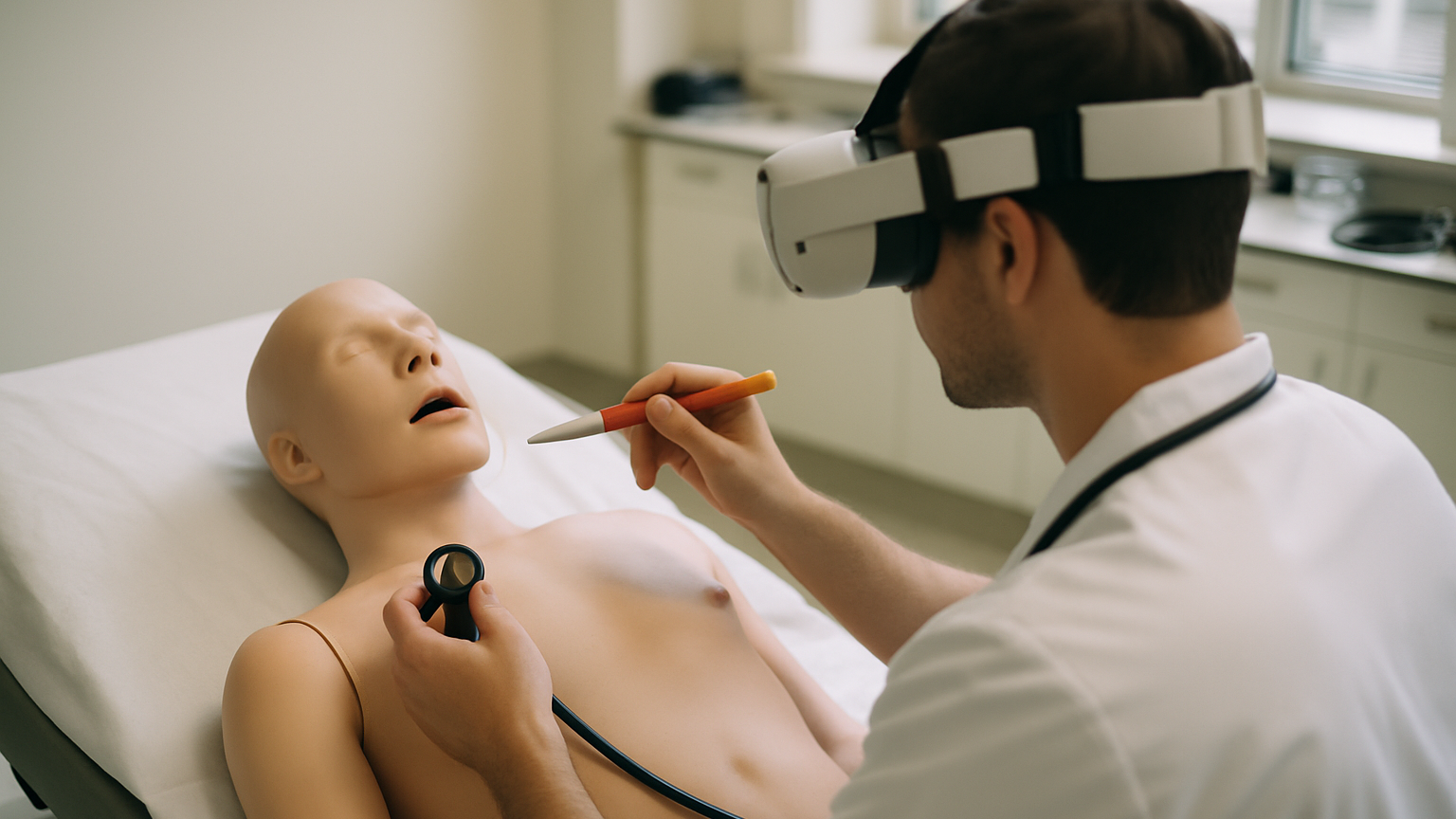
Objective Structured Clinical Examination (OSCE) is a proven way to measure whether learners can do the work, not just talk about it. Moving OSCE in VR keeps the structure that educators trust, while unlocking controlled, repeatable and safe practice environments that simply aren’t possible in a physical corridor of stations. You can standardize patient behavior, scale access, and capture more than a checklist—timing, sequence, and the subtle decisions that reveal clinical judgment. Learners step into a scenario, not a script, and they can repeat it until performance stabilizes. Faculty gain richer data without increasing the burden of supervision. That’s the promise of immersive education when it meets assessment.
At RTE Lab we design, prototype and validate XR, VR and AI-supported solutions that address real training and assessment needs. The focus is practical: build scenarios that map to learning outcomes, make them usable for students and faculty, and verify that they work in real-world conditions. Our approach blends technology development, user experience design and clinical context analysis with close collaboration across academic and medical teams. If you’re exploring immersive pathways for medical assessment and training, start by scanning what’s already possible with our MedTech XR & AI solutions. In practice, most cohorts need two or three runs before timings stabilize and anxiety drops—so we plan for that from day one. The goal is not novelty, but reliable competence building.
Why OSCE in VR Elevates Medical Education
Immersive stations bring the OSCE philosophy—short, focused tasks with clear objectives—into a medium built for deliberate practice. With presence and realistic pacing, learners experience pressure, uncertainty and patient variability without clinical risk. OSCE in VR makes it easier to keep conditions equivalent across attempts and cohorts, because environment, case cues and timing are controlled by design. That leads to cleaner comparisons and fewer confounders when you measure progress. It also widens access: evening runs, remote sessions, and extra practice windows become logistics, not roadblocks.
Communication and soft skills benefit, too. Virtual patients can be scripted for empathy challenges, language barriers or challenging behaviors, and response pathways can branch based on student choices. Instead of pass/fail snapshots, you collect the story behind the score—how a student opened the visit, clarified concerns, or handled a safety-critical cue. In practice, small design choices—like when a virtual patient hesitates or interrupts—have outsized impact on learner engagement and outcomes. That’s where immersive simulation shines: it lets you tune nuance and see how learners adapt.
There’s an honest boundary, though. Virtual stations are not a replacement for bedside time, nor will they replicate tactile nuance for procedures that rely on haptics. If your immediate need is advanced tissue handling or device feel, a task trainer or in-situ sim remains the better fit. And if your assessment culture only values one-shot, high-stakes encounters, the iterative practice potential of VR may be underused. Use it where standardization, decision-making and communication matter—and where repeatability accelerates learning.
Designing Valid And Reliable Virtual OSCE Stations
Start with construct clarity. Blueprint each virtual OSCE station against specific competencies—history-taking focus, focused exam flow, medication reconciliation, escalation criteria—and derive observable behaviors before thinking about interaction bells and whistles. Map every checklist item to an objective and decide which are critical errors versus desirable behaviors. Keep scenario length tight enough to maintain cognitive load, but rich enough to surface decision points. Finally, predefine timing windows: when prompts appear, when a patient escalates, and when the station auto-ends.
Reliability lives in standardization and calibration. Use scripted patient logic, controlled cues and consistent environmental distractors so each learner faces the same challenge. Pilot with faculty and a small learner sample to tune clarity, difficulty and scoring thresholds, then lock the exam build. To support this cycle, we combine scenario creation, UX testing and clinical oversight through our research and development studio, moving from idea to validated concept before scaling. The outcome is a station that measures what it claims to measure—and does so repeatably.
UX details matter more than they seem. Clear onboarding and a 60–90 second warm-up interaction reduce cognitive overhead that can skew early attempts. Interaction models should be simple and consistent—point-and-speak, gaze-and-confirm, or controller-based selection—so performance reflects competence, not controller mastery. Design with accessibility in mind: subtitles, adjustable font sizes, color-safe UI, and seated options where possible. And plan for edge cases: what happens when a student stays silent, over-clicks, or tries a creative but acceptable workaround?
Assessment And Feedback At Scale
Scaling feedback is the superpower of virtual assessment. When stations capture structured interaction data by default, faculty move from labor-intensive observation to targeted review. Dashboards can highlight outliers, common error patterns and timing bottlenecks across a cohort. That makes remediation more surgical: you fix the step that breaks, not the whole process. It also supports program-level decisions—where to add teaching time, where to change case complexity, and which competencies mature fastest.
Performance Metrics That Matter: Checklists, Timing, Error Types
Go beyond binary checklists. Track sequence fidelity (did the learner verify allergies before prescribing?), time-on-task for critical steps, and response latency to safety cues. Classify errors by type: omission, commission, order violation, or escalation failure. Note recovery behaviors—the moment a learner corrects course often signals deeper competence than a flawless run. With this structure, a pass means the right things happened at the right time for the right reasons, and a fail points to teachable gaps, not vague impressions.
Structured Debriefing In VR: Replay, Annotations, Reflection
Debrief is where learning consolidates. Instant replay with timeline markers lets learners jump to key moments: a missed red flag, a strong rapport turn, a rushed summary. Faculty or the system can attach annotations to those moments, linking them to objectives and guidelines. Encourage brief self-reflection prompts right after the session—two or three focused questions beat a generic form. Over time, these artifacts build a portfolio that shows growth, not just isolated scores.
AI-Assisted Scoring And Communication Analysis
AI can support consistency by analyzing transcripts and voice features to flag empathy markers, closed-vs-open questioning patterns, and clarity of summaries. Use models to pre-score segments, then let faculty validate and override—humans stay in the loop, especially for borderline calls. Train and calibrate with diverse data to minimize bias, and monitor drift over time so your rubrics don’t quietly shift. The win is speed with transparency: quicker feedback, clearer rationale, and an audit trail for decisions. Keep it simple at first; complexity can come later if it proves value.
Curriculum Integration, Logistics And Exam Integrity
Integration starts with alignment. Place stations where they reinforce recent teaching—ideally within days, not weeks—so knowledge transfers into action. Define the cadence: formative practice windows, a mid-module checkpoint, and a summative OSCE in VR when competence should consolidate. Provide a short pre-brief that clarifies objectives and interaction basics, and a debrief path that’s predictable across courses. Faculty workflows matter; aim for authoring tools and review views that fit how your teams already work.
Logistics are solvable with planning. Decide on seated versus room-scale early, size the headset pool, and set up a simple booking system to avoid queues. Build a 10-minute onboarding station into the schedule so the first graded station isn’t a tech tutorial. Plan hygiene, charging and device rotation like you would schedule rooms and standardized patients. For remote runs, consider bandwidth variability and provide an offline fallback for practice content if assessment rules allow.
Exam integrity blends design and process. Randomize case variants, lock external resources when appropriate, and use identity verification and proctoring protocols that match the stakes. Secure builds should ship as signed packages with version control, and every session should leave an immutable activity log. Be practical about risk: remote, unsupervised, high-stakes exams demand stronger safeguards than on-site formative runs. If your program requires regulator-recognized equivalence for licensure decisions right now, stick to established formats while you validate VR stations locally.
Equity and wellbeing are part of integrity. Offer accessibility settings, provide alternatives for learners with motion sensitivity, and keep tech support visible during peak periods. Don’t assume digital fluency—short, repeated practice slots level the field. Collect student feedback on usability and psychological safety alongside outcomes data. When those signals improve together, you know the integration is working.
From Pilot To Scale With R&D, Grants And University Partners
The fastest path to impact is a focused pilot. Co-design one or two stations with faculty and students, test with a small cohort, and secure early validation data for a grant or curriculum committee. RTE Lab’s process supports grant-funded projects and collaborations with university and healthcare innovation programs, so evidence generation is built in from the start. We’ve applied the same human-centered methods across therapy, communication and training scenarios—including structured cognitive training delivered through our Focus VR platform—which proves that complex, repeatable protocols can scale in VR. Different use case, same rigor.
Treat the pilot as a living lab. Define success metrics up front—completion rates, inter-rater agreement, time to competence—and iterate quickly on scenario flow and UI. Share short evidence summaries with stakeholders so support grows with each cycle. No magic, just structure and repetition. When the data shows reliability and student acceptance, expand to more stations and integrate across courses.
Scaling is a team sport. Train faculty reviewers, appoint technical stewards, and set governance for content changes and versioning. Build a roadmap that sequences additional competencies and maps them to assessment windows. RTE Lab supports this end-to-end—interactive prototypes, proof-of-concept builds, scenario creation, and the XR training infrastructure that makes deployment practical—so programs can move from idea to validated concept and into sustainable delivery. Done well, immersive assessment becomes a dependable part of the curriculum rather than a one-off experiment.