
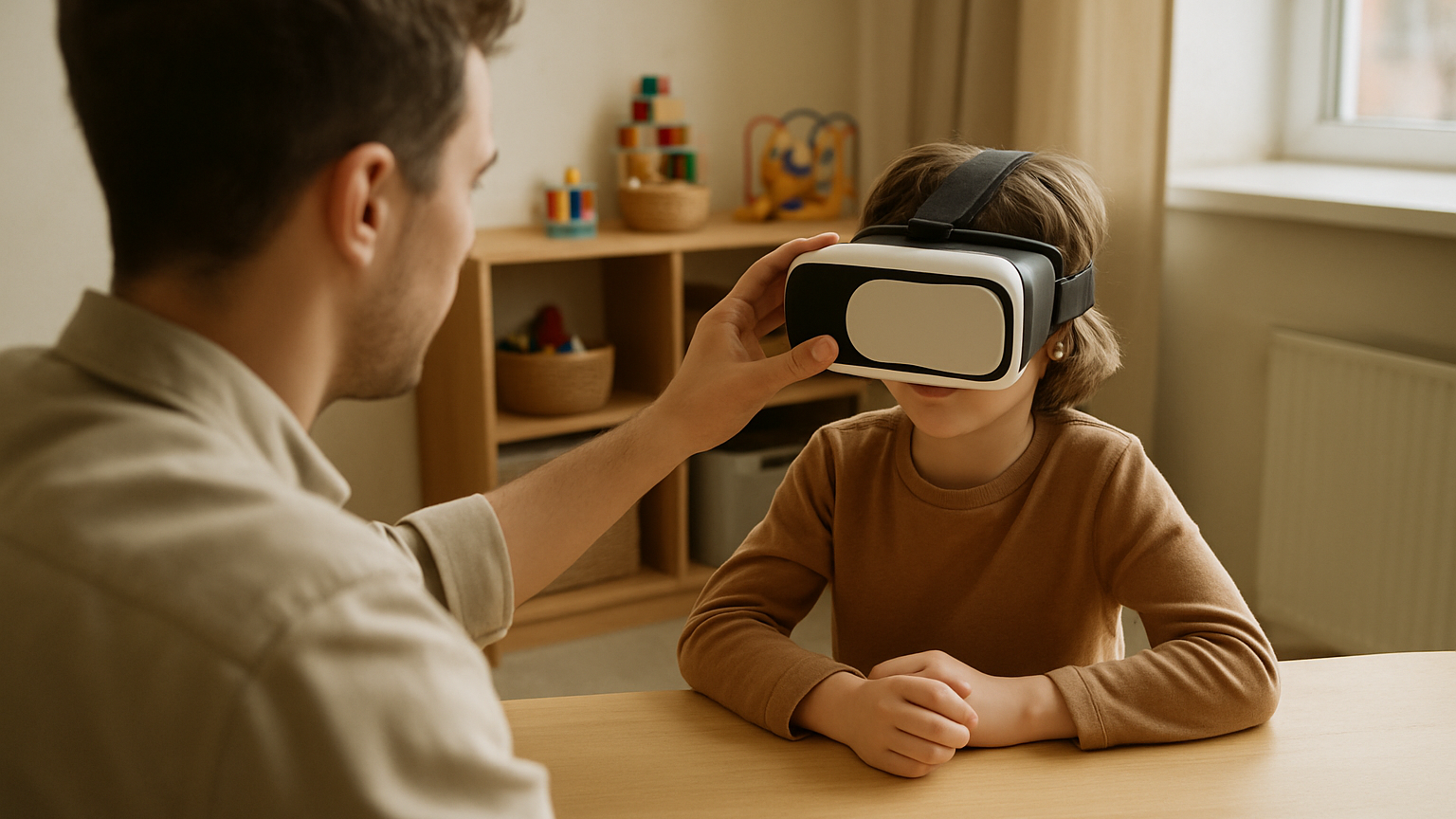
Harmony VR is built for real clinical work: a calm, predictable virtual space where children on the autism spectrum can practice social, emotional, sensory and cognitive skills — step by step, without the noise of the outside world. If your team has been exploring VR for autism therapy, this is a platform you can bring into session plans now, not “someday.” It creates structured, sensory‑aware environments and keeps each activity under therapist guidance, so the child can engage at their own pace. That combination matters when you need repeatable sessions, adjustable complexity and a way to introduce new situations gradually. Curious what it looks like in practice? Start with the Harmony VR experience to see how it supports therapy and education in a controlled, engaging format.
RTE Lab designs immersive healthcare tools with a human‑centered R&D approach, collaborating with academic and innovation programs to keep clinical needs front and center. Harmony VR reflects that approach: predictable interactions, clear visual cues, music and rhythm‑based activities, and therapist‑guided planning are built in by design. It’s not about flashy graphics; it’s about giving clinicians a controllable environment that’s easy to adapt and repeat across sessions. In other words, fewer variables to manage — and more attention on the child’s responses, regulation and progress. If you’ve been weighing whether VR in autism therapy can fit within your workflow, you’ll find Harmony VR aligns with the way therapists actually run sessions.
Why VR for autism therapy with Harmony VR drives engagement
Engagement grows when the environment is predictable and the sensory load is right-sized. Harmony VR creates calm, structured spaces where children can focus on a single task without competing stimuli, and then gradually add complexity as tolerance improves. That means activities like following a visual cue, recognizing an emotion or coordinating a movement can be introduced one by one, instead of all at once. Because the scenarios are repeatable, you can revisit the same task with small tweaks — new cue, slightly longer duration, one extra step — to consolidate learning without overwhelming change. Therapists stay in the lead, so the child’s pace sets the agenda, not the software.
Another reason VR for autism therapy resonates here is the balance of multisensory input and clarity. Music and rhythm interactions in Harmony VR are engaging by nature, yet presented in a controlled way: clear visuals, simple choices, and feedback that’s easy to understand. Children can tap virtual instruments, match rhythms or follow sound‑based prompts while the therapist observes regulation and adjusts stimulation. When a child shows readiness, a social element can be layered in — a character to respond to, a facial expression to identify, a short interaction to complete — still within the same structured frame. The result is attention that holds, because the environment supports it.
There’s also a practical edge for teams: fewer logistics than real‑world setups for the same skill. Need to practice turn‑taking or responding to a visual cue? Launch a known scene and you’re ready in seconds, which preserves the child’s momentum and your session time. No fluff, just tools that work in session. If your model requires completely free, unstructured play without therapist oversight, Harmony VR won’t be the right fit — it’s built for guided, goal‑oriented practice.
What A Session Looks Like: Safe, Structured, Therapist-Guided
Sessions begin with planning: the therapist selects the activity path, aligns it with the child’s therapeutic or educational goals and sets the initial level of stimulation. Harmony VR supports specialist‑guided activity planning, so choices stay intentional — which scene, what cues, when to step up difficulty. The first minutes often focus on orientation and regulation inside a calm multisensory space, giving the child clear, simple interactions to build comfort. When readiness shows up — body settles, attention holds — you move into the primary task and keep the structure consistent. In practice, most therapists start small and extend as the child settles.
During activities, clarity is the goal: single instructions, visible cues, feedback that makes sense to the child. The therapist can pause, repeat or slightly modify tasks without resetting the whole experience, which keeps transitions smooth. Because Harmony VR is designed to be sensory‑aware, you can reduce unnecessary distractions and dial in to the child’s needs. That might be dimmer visuals, fewer on‑screen elements or a simpler rhythm pattern — small changes that meaningfully adjust the load. The safety here is twofold: emotional safety from predictable steps and practical safety from running in a controlled, virtual space.
Closing a session looks like consolidating and preparing the next one. You recap the task, note regulation and responsiveness, and decide whether to repeat, extend or switch modules next time. The repeatability of VR scenarios turns this into a clean loop: same environment, next increment, measurable response. If you want to place the session within a broader program of innovative care, RTE Lab’s portfolio of our immersive healthcare solutions shows how consistent, human‑centered design translates across tools. That way, progression isn’t accidental — it’s designed in.
Harmony VR Modules And Outcomes Your Team Can Tailor
Harmony VR provides modules that you can adapt to each child’s pathway: music and sensory interaction, social and emotional learning, and structured practice that’s easy to repeat and adjust. The platform supports adjustable task complexity and keeps choices transparent, so therapists can scale challenge without losing predictability. Outcomes you’re targeting — from following cues to recognizing emotions or coordinating movement — can be introduced gradually and revisited as needed. Because sessions are therapist‑guided, the same module can serve different goals across children and over time. That flexibility is what makes it practical beyond a single pilot.
Music And Rhythm Activities For ASD Support
Rhythm‑based activities are a core element of Harmony VR. Children can interact with virtual instruments, match simple patterns and receive immediate, understandable feedback. These tasks encourage attention, timing and movement coordination within a calm multisensory environment. Because the therapist controls the setup, you can start with a single sound and one action, then build to short sequences when readiness appears. For many teams, this becomes a reliable entry point to engagement before layering in social elements.
Social And Emotional Learning Scenarios
Social and emotional learning in Harmony VR focuses on clarity and safety. Children practice recognizing emotions, responding to characters and following simple conversational or visual cues — at their own pace. Scenarios avoid overload: one expression to identify, one prompt to answer, one turn to take. With repetition, you can increase variability or add brief interactions to simulate everyday situations while maintaining predictability. It’s the same controlled environment, just a slightly wider window each time.
Consistent Sessions, Adjustable Challenge, Trackable Progress
Consistency is built into the platform: you can run the same session design across weeks and change a single variable to test tolerance or skill growth. Adjustable difficulty — fewer cues, more cues, slower or faster rhythm, shorter or longer sequence — helps tailor challenge without shifting the entire context. Progress is trackable in the way therapists already work: by documenting responses, regulation and successful steps, and aligning next‑session settings to those notes. Over time, that creates a clear arc from initial orientation to more complex interactions, still within a safe frame. This is how small wins add up to meaningful change in a program.
Implementation Made Simple: Setup, Training, And Support
Getting started should feel straightforward. Harmony VR is designed for clinical workflows: quick session selection, clear activity planning and predictable environments that make supervision easier. Your team can set up a structured path for each child and keep variation under control, which reduces ramp‑up time and helps standardize how sessions run. Because the platform focuses on clarity over complexity, therapists spend their time observing and guiding rather than navigating menus. That’s the point — let the clinical work lead.
Training centers on practice: hands‑on orientation for therapists to plan sessions, select modules and adjust difficulty with confidence. Clinicians learn to shape sensory input, read in‑VR responses and decide when to repeat, extend or switch activities. Teams often create a shared library of session plans for common goals, so everyone starts from a proven baseline and adapts as needed. Support continues post‑training, helping you fine‑tune pathways for specific children and integrate Harmony VR into existing schedules. It’s a learn‑by‑doing approach that fits how therapy teams operate.
If you’re evaluating the platform alongside other innovations, RTE Lab’s overview of our R&D process explains how needs discovery, prototyping and clinical feedback shape each release. That matters for long‑term adoption: tools evolve as your requirements evolve. If your program requires fully remote, unsupervised sessions as the primary mode of care, Harmony VR won’t match that model — it’s built for therapist‑guided experiences. For clinics running in‑person or hybrid programs with supervised sessions, the fit is natural.
From Pilot To Rollout: Procurement, IT, And Research Collaboration
A smart path is to start with a focused pilot: a small cohort, clear session goals and predefined indicators like tolerance, engagement and observed skill use. Harmony VR’s repeatable scenarios make pilots easier to compare across sessions and therapists. As you gather observations, it becomes clear where to scale, which modules to prioritize and how to schedule sessions inside your week. That evidence base helps teams communicate value to stakeholders who weren’t in the room. It also creates a shared language across therapists on what “progress” looks like in this context.
Procurement and IT reviews benefit from clarity, too. Because Harmony VR is a structured platform designed for therapy and education, it slots into existing governance with well‑defined use cases and supervised workflows. Your IT team can review hardware, access patterns and support procedures within a controlled scope, rather than an open‑ended sandbox. Collaboration with academic and healthcare innovation programs at RTE Lab further supports due diligence when you need it. The goal is to make approval a process, not an obstacle course.
If research is part of your mission, Harmony VR lends itself to structured study designs: repeatable tasks, adjustable variables and session‑by‑session documentation. It’s a pragmatic platform to explore outcomes like regulation, attention within task, response to cues or readiness for social interaction — always inside a predictable environment. Teams often pair implementation with a light research protocol to learn while they scale. When you want a deeper view into how RTE Lab turns clinical insight into product decisions, revisit our R&D process for the broader methodology. That alignment between practice and evidence is where rollout gets durable.
Extend Your Program: Add The Focus VR Platform For ADHD
Many clinics support mixed neurodevelopmental profiles, which is why extending your toolkit matters. Alongside Harmony VR, RTE Lab offers the Focus VR platform for structured cognitive training in ADHD. When both tools live under one roof, your team gains consistent design patterns and therapist‑guided workflows across conditions. That consistency reduces training overhead and helps families understand how sessions will feel, even if goals differ. The end result is a cleaner, more coherent program.
Operationally, planning becomes simpler too. Therapists can schedule Harmony VR for social‑emotional or sensory‑aware practice and Focus VR for attention and executive function work, aligning sessions without switching to entirely different paradigms. The same principles apply: predictable environments, adjustable difficulty and repeatable tasks that map to clear goals. It’s the difference between juggling tools and running a connected pathway. For multidisciplinary teams, that shared foundation smooths collaboration.
If your question is whether VR for autism therapy can move from idea to everyday — yes, with Harmony VR, it can, because it’s designed for the way clinics operate. And if you also need a pathway for ADHD, Focus VR closes that gap without adding chaos to your workflows. Together, they reflect the same care philosophy RTE Lab brings to immersive healthcare: build environments that are safe, structured and engaging, and let clinicians lead the way. When those pieces align, adoption follows. That’s how modern therapy tools should feel.