
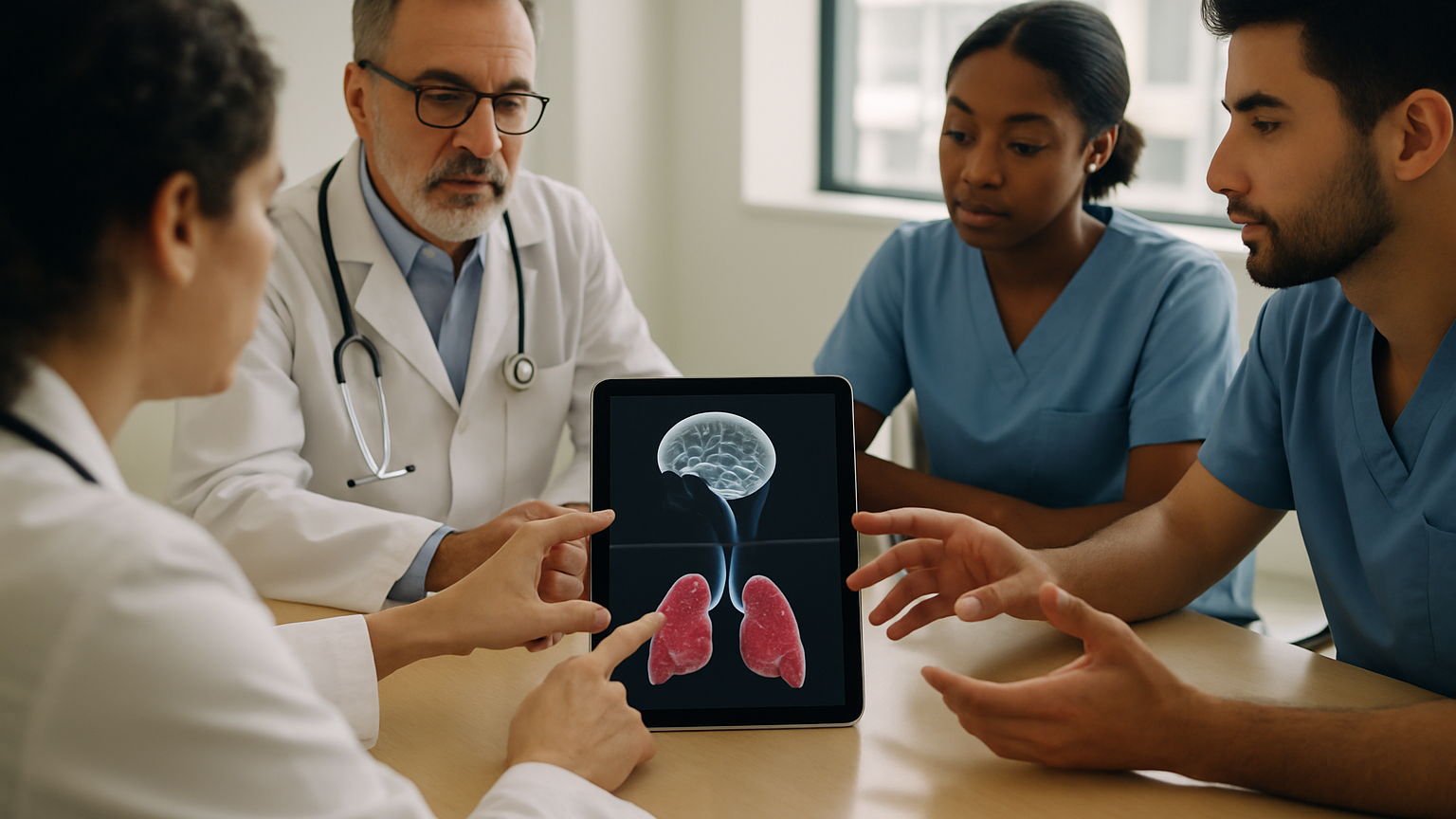
When education meets real clinical pressure, slides and checklists stop being enough. That’s where a healthcare XR development team changes the game: by building controlled, repeatable and engaging environments where learners can practice judgment, communication and procedures safely. The goal is not spectacle; it’s measurable competence. Think of simulation that feels close to the ward, but with a pause button and instant feedback. You can rehearse rare events, observe decisions, and capture performance data without risking patient safety. That’s the promise—and the responsibility—of doing immersive training well.
It also means being honest about fit. If you need weekly text-only updates or have zero access to headsets or a skills lab, this approach may be overkill right now. In practice, most cohorts get comfortable with VR controls in 5–10 minutes—the real bottleneck is usually room scheduling and IT approvals. No fluff, just skills. And if you want to see the breadth of what’s possible across therapy, rehabilitation and training, explore our immersive healthcare solutions.
What A Healthcare XR Development Team Delivers For Education
Start with outcomes. A healthcare XR development team designs scenarios that target specific behaviors: handover clarity, escalation timing, de-escalation language, sterile field discipline, or adherence to stroke pathways. Instead of passively consuming content, learners act: they assess, decide and communicate under time pressure. Every action can be captured and reviewed—what they noticed, when they spoke up, which steps they missed and how they recovered.
For educators, this unlocks repeatable practice. The same complex situation can be run five times with incremental difficulty, or branched into alternative outcomes based on learner decisions. You can design deliberate practice: short, high-frequency sessions that build muscle memory for both psychomotor and cognitive tasks. And because environments are controlled, rare-but-critical cases become teachable on demand.
Layer in AI-supported feedback and you get even more value. Conversational agents can model patient or family responses for clinical communication simulations, while analytics flag patterns like premature closure or poor closed-loop communication. The result is a learning loop: experience, reflection, targeted feedback, and another attempt—faster than traditional simulation logistics allow.
There are limits. If a program must reach thousands of learners instantly without any facilitation, network configuration or device management, high-fidelity XR is not the right first step. Likewise, if your goal is policy awareness rather than behavior change, simpler media may fit better. But when the aim is practice—clinical reasoning, teamwork, rehab adherence—XR becomes a practical teaching tool.
Skills And Roles: Clinicians, Learning Designers, And XR Engineers
Great simulation sits at the intersection of domain expertise, pedagogy and technology. Clinicians ensure clinical accuracy and safety boundaries; learning designers translate goals into observable, assessable behaviors; XR engineers build the interactive world, systems and user experience. Each role checks the others: is the case authentic, is the task measurable, is the interaction intuitive and accessible?
Co-design is the engine. Workshops yield storyboards, decision trees and voice lines; then prototypes expose friction: menus that slow down a code response, visuals that distract from a subtle symptom, or hand interactions that fatigue users. The team iterates not just on the scene, but on the learning flow: briefing, scenario, debrief and transfer to practice.
On the safety side, human factors and infection control are baked in from the start. Comfort breaks to reduce simulator sickness, controller-free options when gloves are required, and clear UX for VR/AR that respects clinical realities. Accessibility matters too—text size, contrast, narration, and left/right-hand modes—to make training usable for more learners, not fewer.
From Needs Analysis To Prototype: Our R&D Process For Training
Defining Learning Outcomes With Clinicians And Educators
Every project starts with people and purpose. Together with clinicians and educators, we translate requirements into concrete learning outcomes and assessment criteria—what should be seen, said, done and documented. We map these to rubrics and checkpoints that a facilitator can observe or the system can log. If you want a deeper look at how we structure this work end-to-end, explore our R&D process.
Scenario Design: Simulation Fidelity, Safety, And UX For VR / AR
Next comes scenario design: choosing VR for full immersion or AR for in-situ augmentation, setting the right level of fidelity, and balancing cognitive load. We design for psychological safety and practical realism—clear instructions, plausible cues, no gimmicks. Interaction patterns, gaze and hand tracking, and spatial audio are tuned to spotlight clinically relevant signals rather than overwhelm learners.
Pilot Studies And Proof-Of-Concept In Hospitals And Schools
Finally, we validate in real contexts through small pilots and proof-of-concept studies. Interactive prototypes let us test usability, learning gains and operational fit: headset hygiene, facilitator roles, device setup flow, and debrief logistics. Feedback loops are short, so scenarios improve quickly before wider rollout. This approach makes immersive education practical to implement, not just impressive in a demo.
Designing Effective XR Training For Communication, Rehab, And Soft Skills
Communication first. Clinical communication simulations let learners practice empathy, clarity and escalation across sensitive contexts—breaking bad news, managing agitation, or coordinating during a rapid response. AI-driven patient or family voices can reflect tone and word choice, while checklists ensure closed-loop communication. Because practice is safe, learners can try different strategies and see the impact immediately.
Rehabilitation benefits from structured, motivating repetition. In VR, task-oriented exercises can be varied and engaging, with adaptive difficulty and clear feedback. For autism spectrum support, rhythm and music-based interaction can improve engagement and regulation—explore the Harmony VR experience to see how sensory design meets therapeutic goals. The key is turning adherence into a rewarding loop rather than a chore.
Attention and executive function training call for precise, repeatable cognitive challenges. With structured sessions and performance tracking, an XR tool can support educators and therapists who work with ADHD. Our Focus VR platform shows how targeted exercises in immersive settings help sustain focus and build routines that transfer back to classroom or clinic.
Soft skills for teams—briefings, debriefings, conflict navigation—translate well to immersive practice too. Short, scenario-based reps let teams try language, feel the room and get feedback before the next shift. This is where an XR team in healthcare keeps fidelity high where it matters (timing, tone, consequences) and trims anything that distracts from the learning target.
Measuring Impact: Assessment, Accreditation, And Clinical Validation
Assessment should be designed with the first storyboard, not tacked on at the end. We align each objective with observable actions, pre/post checks, and OSCE-style rubrics where appropriate. System logs can add objective signals—time-to-action, error recovery, sequence adherence—while facilitators comment on teamwork, tone and clinical reasoning. The combination supports both learner growth and program evaluation.
For accreditation, we map scenarios to recognized competencies and document instructional design decisions, evidence, and assessment tools. Some programs need credit-bearing courses; others want CPD-ready modules they can submit for review. If you need formal accreditation approved within days with no piloting, immersive builds may not fit that pace. With a planned path, though, XR becomes straightforward to justify.
Clinical validation grows from partnerships. Small feasibility pilots in hospitals or schools test usability and early outcomes, then larger studies examine effectiveness and implementation. Collaboration with academic and healthcare innovation programs helps ensure rigor while keeping the work practical for educators and clinicians who will run it day to day.
Working With RTE Lab: XR Training Simulations And Neurodevelopmental Tools
RTE Lab designs, prototypes and validates XR, VR and AI-supported solutions for healthcare education and therapy. From interactive prototypes and proof-of-concept solutions to rehabilitation scenarios and clinical communication simulations, our work is human-centered and research-driven. We focus on real user needs and contexts—patients, therapists, educators, students and clinicians—so experiences are understandable, usable and relevant in practice.
Engagement typically starts with a discovery session and needs analysis, then moves into rapid prototyping and pilot implementation. Together we define outcomes, build scenarios, and test with small cohorts before scaling. A healthcare XR development team is most effective when there’s a clear educational champion, time for iteration, and access to spaces where training can run reliably.
If you’re expecting instant, system-wide rollout with no facilitator time, no operational change and no device management, this probably isn’t the right moment for immersive training. But if your goal is to turn critical skills into repeatable practice, we can help structure a path that balances ambition with feasibility. After a few sessions, one issue usually comes up: someone asks when IT security can greenlight broader access—good signal that the training is working and people want more.
Whether you’re exploring XR training simulations, VR-based therapy support or neurodevelopmental tools like the Focus VR platform and the Harmony VR experience, we build with one aim: make immersive technology a practical tool for education. If you’re ready to move from idea to validated concept, take a closer look at how we work across research and development in our R&D process.