
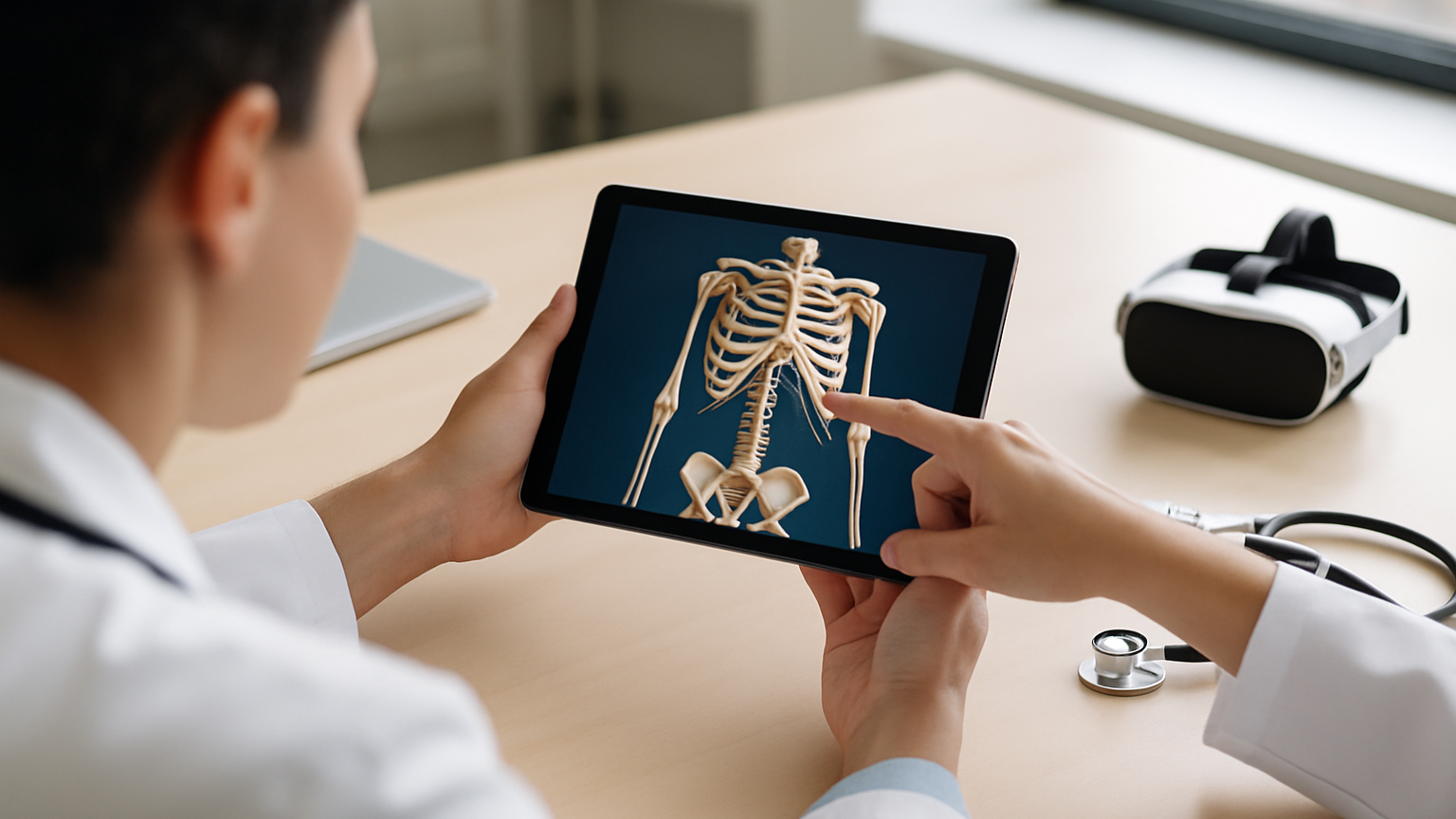
Ideas are easy; turning them into safe, effective training is the hard part. In medical education, we need students and clinicians to practice complex decisions and communication without risking patient safety. That’s where rapid XR prototypes pull their weight — they make scenarios tangible early, so you can see what works and what falls flat. Instead of debating slides and storyboards for weeks, you can put a headset on an instructor tomorrow and learn from real reactions. Not theory, not hype — usable insight that moves projects forward.
Think of this article as a field guide to building educational value with medical XR prototyping. We’ll walk from the first sketch of a scenario to a validated concept that fits your curriculum, your learners and your constraints. Along the way, we’ll talk about sprint rhythms, scenario design, classroom realities and what to measure so your program survives beyond the pilot. And yes, we’ll be honest about where XR helps and where it gets in the way. Because budgets, schedules and faculty bandwidth are real, not theoretical.
At RTE Lab we design, prototype and validate immersive solutions with a human-centered R&D approach, but the principles here apply whether you build in-house or with a partner. Start with people, not hardware: learners, faculty, patients and the clinical setting define the constraints that matter. Then choose the minimum technology that can teach the skill, not the maximum fidelity you can afford. If that sounds pragmatic, good — pragmatic is what actually gets adopted. We’ve seen beautifully rendered apps gather dust while simple, well-scaffolded scenarios become faculty favorites.
Why XR Prototyping Matters For Medical Education Today
Clinical practice is messy, variable and time-limited. Students can go weeks without seeing a case that’s perfect for a given skill, and when the moment arrives there’s little room to press pause and reflect. XR lets you rehearse that moment on demand, under pressure yet without risk, until the behavior sticks. With prototypes, you can create controlled, repeatable and engaging environments fast, long before you invest in full-scale production. That speed changes decisions: you stop guessing and start testing.
Prototyping matters because curriculum fit is where educational technology lives or dies. A low-fidelity build lets faculty validate objectives, pacing and debrief prompts in real sessions instead of slide decks. Learners give immediate feedback on clarity and cognitive load, and you can spot practical blockers like room setup, infection control, or headset hygiene. Iteration here saves months of rework and avoids the trap of shipping a polished app that doesn’t teach what you hoped. You learn cheaply, you learn early, and you learn with the right people in the room.
Still, prototyping is not a magic shortcut. If you need a fully deployed, multi‑site program next month, this isn’t your path. And if the goal is to ‘wow’ stakeholders with a glossy demo rather than improve outcomes, medical education will sniff that out fast. Skip this route if you’re buying headsets first and only later planning what anyone should learn. XR helps when it serves pedagogy, not the other way around.
From Idea To Validated Concept: How We Run Prototyping Sprints
We start with a concise brief: who is the learner, what decision or behavior must change, and how will we know it worked. That becomes a one-page objective map with success criteria, constraints and a first sketch of assessment. Next we co‑create a scenario outline with faculty and clinicians, translate it into a storyboard and interaction map, and only then touch a game engine. The first build is deliberately lean — an interactive prototype or proof‑of‑concept focused on the core learning loop, not the graphics. Think handle placement, prompts, timing and feedback, not textures and lighting.
We test that build with a small group of representative learners and one facilitator, capturing both performance data and narrative feedback. We watch for hesitation points, errors that repeat, and whether the scenario scaffolds reflection in the debrief. Based on the signals, we tune objectives, content and UX in short cycles until the experience is reliable enough to pilot. If you want the deeper anatomy of this approach, see our Research & Development process — it’s built around human‑centered iteration in healthcare contexts. The headline is simple: validate the concept with medical XR prototyping before you scale.
Before a pilot, we lock down the unglamorous bits that decide adoption: IT requirements, privacy and security reviews, headset hygiene, room logistics, and faculty onboarding. We package the experience with job aids — facilitator checklists, brief and debrief scripts, troubleshooting one‑pagers — so busy educators can run sessions without a technician at their elbow. This is where structured product development meets classroom reality. Only when those pieces hold together do we invest in higher‑fidelity content or additional scenarios. Because repeatability and reliability beat wow‑effects every single time.
Designing Training Simulations That Teach Skills, Not Just Tech
Start with the skill, not the scene. Whether you’re designing a clinical communication simulation or a technical task, clarity on the target behavior sharpens every design choice. If the goal is shared decision‑making, you need branching dialogue, emotional cues and time pressure; for a procedural task, you may need spatial accuracy and immediate feedback on errors. In both cases, choose the minimum fidelity that preserves the learning signal. That restraint keeps costs sane and makes updates faster as guidelines evolve.
Debrief isn’t an afterthought — it’s part of the design. We embed observable behaviors and decision points that map to checklists or rubrics faculty already trust, then surface them clearly after the run. In practice, most educators tell us the debrief is where the learning clicks, not inside the headset. So we prioritize prompts, visualizations and transcripts that help learners explain their choices and plan a next attempt. The headset is rehearsal; the conversation is where judgment grows.
Access matters too. Not every learner tolerates long VR sessions, and not every room supports full‑scale movement; good UX for VR/AR offers seated modes, comfort options and short loops with breaks. We watch cognitive load: too many concurrent stimuli and learners memorize clicks instead of reasoning. Audio descriptions, readable UI and alternative input methods widen participation without diluting rigor. The goal is a simulation that rewards clinical thinking, not just game skill.
What medical XR prototyping Looks Like In The Classroom
On the day of teaching, medical XR prototyping shows up as a lightweight, repeatable routine. One faculty member runs the room, a small group cycles through the scenario while peers observe, and everyone meets in a short debrief. Headsets are prepped with a simple launcher, session data is logged automatically, and backup plans exist for the inevitable hiccup. Students feel the pressure of the moment, yet they know they can reset and try again in minutes. Faculty keep control of timing and objectives instead of wrestling with menus.
The first two sessions are usually slower while everyone learns the flow, then the cadence settles and confidence grows. Observers quickly become co‑teachers, spotting decision points and offering alternatives during debrief. We keep scenarios short enough to run two attempts per learner — one cold, one after feedback — to reinforce improvement. The tech hums in the background while pedagogy takes the front seat. That balance is the difference between novelty and a sustainable program.
Clinical Communication Simulations And Soft-Skills Practice
Communication training thrives in XR when stakes and emotions are present but real patients are not at risk. We simulate difficult conversations — delivering bad news, negotiating next steps, navigating cultural or language barriers — with branching dialogue and realistic non‑verbal cues. Learners practice tone, pacing and empathy while receiving structured feedback aligned to your rubric. Because sessions are repeatable, faculty can calibrate what ‘good’ looks like and track progress across a cohort. It’s a practical extension of our clinical communication simulations work, tuned for classroom rhythm.
Rehabilitation Scenarios And Therapy Support
For rehabilitation and therapy support, XR lets learners explore graded challenges safely, observe compensatory patterns and understand how small changes in task setup shift outcomes. Scenarios can emphasize coaching language, cueing strategies and patient motivation, not just mechanics. Short loops with measurable targets help students build confidence before they meet real patients. Educators can switch parameters live — range, assistance, distractions — to demonstrate clinical reasoning in action. This mirrors our rehabilitation scenarios approach, where repetition and feedback make the difference.
Neurodevelopmental Tools For ADHD And Autism
In neurodevelopmental contexts, prototypes focus on attention, regulation and social cues without overwhelming the user. We build tools that adjust stimulus intensity, task duration and feedback style to match learner profiles and therapeutic goals. For educators, the value is seeing how design choices affect engagement and behavior — a living lab for future clinicians. Sessions remain short, structured and flexible so they fit within existing coursework. These ideas connect directly to our neurodevelopmental tools for ADHD and autism, designed to support both training and therapeutic exploration.
Pilots, Evidence And Grant Funding: Getting From Lab To Program
Turning a prototype into a program starts with a focused pilot. Pick one course or rotation, one faculty champion and a tight set of outcomes you can actually measure this term. Align with your institution’s review and IT processes early; collaboration with university and healthcare innovation programs speeds this up and strengthens your evidence plan. Keep scope humble and logistics robust so the pilot runs even when someone calls in sick. Then share results in the places your faculty trust — curriculum committees, teaching rounds, internal showcases.
Evidence should mix learning outcomes with operational signals. Use checklists or rubrics you already apply in OSCEs or practical exams, gather pre/post self‑efficacy when relevant, and document changes you observe during debrief. Track attendance, rescheduling rates, faculty time on setup, and the number of replays learners request. Those simple measures tell a convincing story about feasibility and impact without inflating claims. They also become the backbone of your grant narrative.
Many teams secure external funding once a pilot shows promise. Grants favor projects that tie immersive tech directly to patient safety, workforce readiness or access to training, and that specify how prototypes evolve into maintainable tools. If you need a partner to harden the build, integrate analytics or expand scenarios, explore our XR & AI MedTech Solutions — designed to move from sprint outcomes to scalable delivery. Reviewers appreciate pragmatic roadmaps over glossy mockups. Keep your claims modest and your implementation plan specific.
What To Measure: Learning Outcomes, Adoption And ROI
Measure what you teach. For knowledge checks, integrate brief quizzes outside the headset; for behaviors and judgment, anchor metrics in observable actions and decisions inside the scenario and in the debrief. Map those to existing competencies so faculty see continuity with their assessment culture. Beware of teaching to the test: if learners memorize click paths, the design needs adjustment. Useful data feels like coaching, not surveillance.
Adoption is a metric, not a vibe. Track onboarding time, first‑time success rate, common support issues and how often sessions are cancelled or rescheduled. Look at facilitator effort: does one person run the room confidently after a short briefing, or does every class need an engineer? If nobody uses it after week three, you don’t have a training solution — you have a toy. These signals tell you where to simplify workflows or add better job aids.
Return on investment in education is rarely a single number. Mix direct costs (hardware, content, training) with cost avoidance (fewer cancelled labs, less consumable use, reduced faculty overtime) and long‑term value (standardized exposure to rare cases). Consider utilization: a great module that runs three times a year has a different ROI than one used weekly across cohorts. Design for reuse and updates so your content survives guideline changes without a full rebuild. Sustainability beats splash every time.