
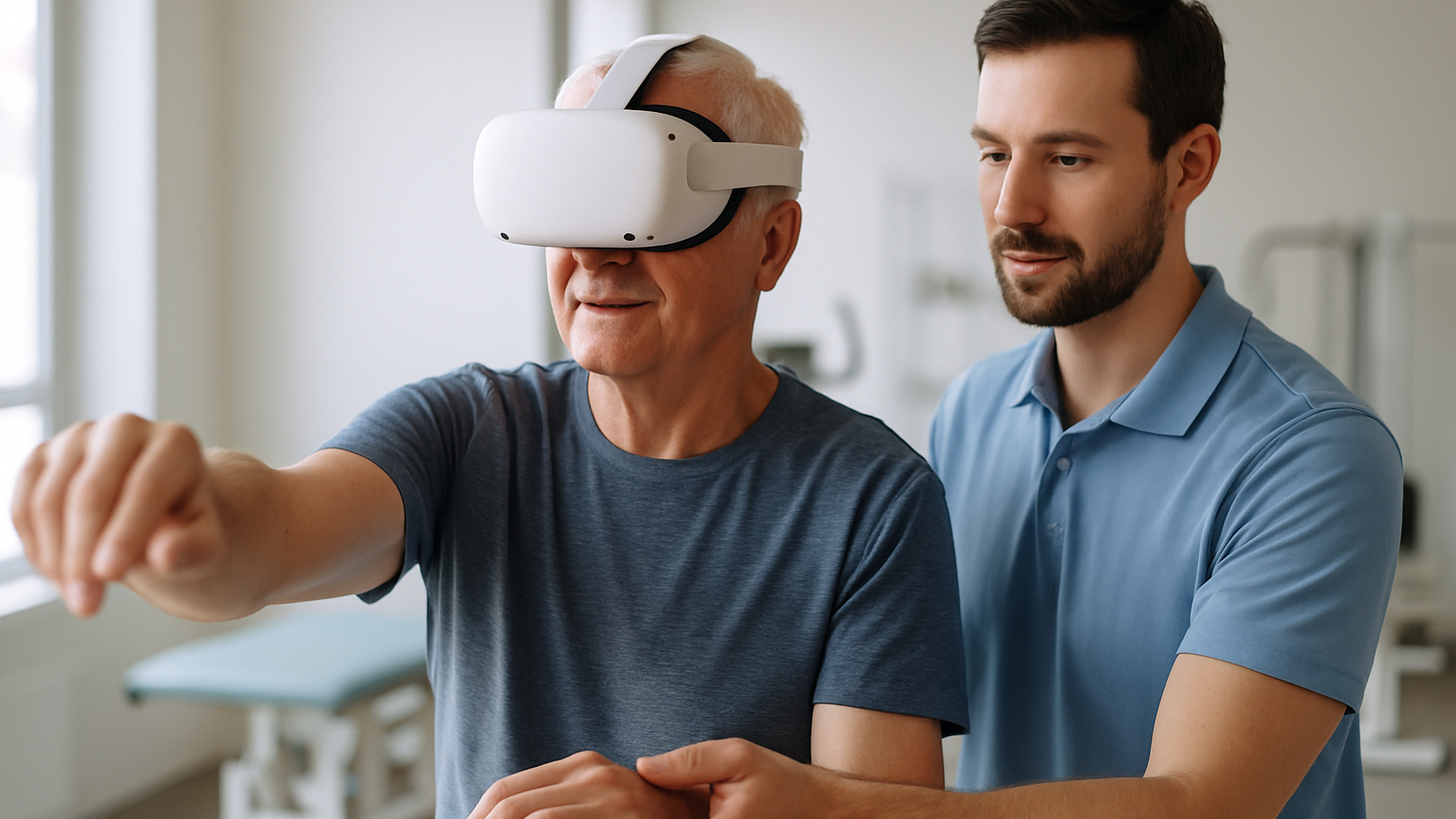
Post‑stroke recovery asks for three things: repetition, relevance and reliable data. VR stroke rehabilitation gives clinicians a way to deliver all three in controlled, engaging environments that feel closer to daily life than a set of cones in a corridor. Imagine reaching to place a virtual cup on a shelf, tracking range of motion and trunk control at the same time — and doing it safely, without leaving the therapy room. At RTE Lab, we focus on human-centered design so the technology adapts to people, not the other way around. We design, prototype and validate XR and AI-supported experiences with patients, therapists and clinicians involved from the start. The result is therapy that can be tested, improved and implemented where it actually matters: in clinical workflows.
Immersion matters because presence changes behavior. When a person feels truly “in” the task, they practice longer and with fewer distractions, while therapists get structured data rather than gut feeling alone. That is why our work spans scenario creation, user experience design and technical development — all geared toward functional goals like reach‑to‑grasp, balance or dual‑task walking. If you are exploring innovative healthcare technologies, take a look at our XR & AI MedTech solutions to see how training, therapy support and patient engagement fit together. We do not build tech for its own sake; we build it to make practice repeatable and measurable. And we keep the bar practical: if it does not help a session run better, it does not ship.
Still, immersive therapy is not a silver bullet. It works best when it amplifies proven rehabilitation methods, provides objective feedback and motivates people to come back tomorrow. Our role is to translate clinical goals into interactive, testable experiences and then iterate with real users. That means early prototypes, structured observations and a clear path toward pilot implementation with institutional partners. It also means acknowledging constraints like space, set‑up time and patient tolerance from day one.
Why Immersive Rehab Matters For Post‑Stroke Recovery
Recovery after stroke benefits from high‑quality, high‑frequency practice tied to meaningful tasks. VR in stroke rehabilitation creates repeatable environments where patients can safely attempt difficult movements without fear of falling or bumping into furniture. Because the scene is under full control, clinicians can scale complexity step by step — fewer distractors, closer targets, slower pace — and see what truly changes performance. Presence also helps with attention: people tend to focus more when the task feels real and relevant. That mix of engagement and control helps teams work toward functional outcomes while collecting objective measures along the way.
Immersive scenarios are designed around real‑world goals: preparing a snack, sorting items, navigating a hallway, or practicing safe stepping reactions. When these tasks are simulated, therapists can isolate components like shoulder flexion or weight shifting without losing the big picture. In practice, many teams start with short sessions and extend duration as tolerance builds. Over time, the same scenario can evolve from seated reaching to dynamic standing with dual‑task elements. Because conditions are standardized, changes in performance are easier to compare across sessions.
Motivation is not a nice‑to‑have — it is often the difference between one set and five. Immediate feedback, clear goals and visual evidence of progress keep patients engaged, while therapists can adjust targets to nudge the challenge just enough. No fluff, just practice that counts. The immersive layer turns repetition into purpose, which is what helps people return and push a bit further next time. And when patients feel in control of their progress, adherence usually follows.
What VR stroke rehabilitation can and cannot do today
On the “can do” side, virtual reality stroke rehabilitation can increase practice volume, make therapy more engaging and provide granular data on movement quality. It can support graded exposure to tasks that are risky in the real world, like reaching outside the base of support. It can help with adherence through goal‑oriented scenarios and immediate feedback. It can also extend access through supervised remote sessions, provided the clinical context and safety protocols are in place. For clinicians, it adds structured measurement to observation, helping track trends more objectively.
What it cannot do is replace skilled therapists or hands‑on techniques where they are essential. Some patients will not tolerate head‑mounted displays due to motion sensitivity, visual issues or cognitive overload, and that is a hard stop. If your clinic requires exclusively hands‑on manual therapy or has no room for set‑up and sanitization, a headset will be the wrong tool. Certain conditions — for example photosensitive epilepsy or severe vestibular disorders — may also contraindicate immersive exposure. Honest fit assessment beats enthusiasm every time.
There are also workflow realities. Headsets need cleaning, software requires updates, and scenarios benefit from occasional calibration to maintain accuracy. Staff training and a short onboarding for patients are part of the plan, not an afterthought. Connectivity and data governance must meet institutional standards before any remote features are enabled. When these pieces are accounted for up front, teams tend to move from novelty to routine use more smoothly.
Inside Our Research And Development Process
Every project starts with people: patients, therapists, clinicians and caregivers. We identify the problem, define user needs and expected outcomes, then select the right technology — not the other way around. This is the backbone of our research and development process, where we connect immersive experience design with healthcare and psychology to make solutions understandable, usable and relevant. We translate goals into testable hypotheses and plan how to observe, measure and iterate. The aim is to move from concept to something real that can be evaluated in context.
From there, we build interactive prototypes and proof‑of‑concept solutions that clinicians can try with patients. Scenarios are designed to be controlled, repeatable and engaging, with parameters that adjust as people progress. We collect qualitative and quantitative feedback and refine usability, comfort and task design. Collaboration with academic, medical and institutional partners keeps the work grounded in evidence and practical constraints. We design, prototype and validate until the core experience consistently supports the intended therapeutic goals.
When a concept is ready, we prepare it for pilot implementation. That may include documentation, training materials, and alignment with clinical protocols and IT requirements. Our R&D process supports grant‑funded projects and benefits from multidisciplinary teams, which helps navigate approvals and timelines. The objective is simple: a validated concept that stands up in real‑world environments, not just in a lab. The moment a scenario proves difficult to use, we go back and adjust.
AI + XR For Personalized Therapy And Patient Engagement
Immersive hardware is only half the story; personalization keeps people practicing. We combine XR with AI to tune tasks in real time, match challenge to capability and surface insights that help clinicians plan the next session. The goal is not to automate therapy, but to support it with better information and a smoother feedback loop. When a patient sees their progress and feels the right level of challenge, engagement follows. And engaged practice is what moves the needle.
Adaptive Difficulty And Task Progression
Adaptive systems adjust parameters like target size, reach distance, speed and cognitive load based on ongoing performance. If accuracy drops, targets can slow or enlarge; if completion rates climb, the environment can introduce gentle dual‑task elements. Over sessions, this creates a clear progression that feels achievable rather than overwhelming. Clinicians retain control, choosing when to lock settings or when to let the system suggest the next step. It is assistive intelligence designed for therapy, not a black box.
Real-Time Feedback And Motivation Loops
Real‑time visual and auditory cues turn abstract goals into immediate signals: straighter trajectory, steadier trunk, cleaner grip. Simple, meaningful feedback helps patients correct mid‑movement instead of waiting for the debrief. Progress views celebrate small wins — more reps, better accuracy, fewer compensations — which is often what keeps people coming back. Therapists can annotate sessions to connect data with clinical notes. Motivation is not a gimmick here; it is a clinical tool to increase therapeutic dose.
Remote Monitoring And Clinician Dashboards
When remote supervision is appropriate, dashboards give teams a clear view of adherence and performance trends across sessions. Clinicians can review goals, adjust parameters and flag scenarios that need in‑person follow‑up. Data stays tied to outcomes, not just numbers for numbers’ sake. This creates a shared picture of progress that patients understand and therapists trust. It is a bridge between session‑based care and continuous support.
From Prototype To Pilot: Building Validated Rehabilitation Scenarios
A solid scenario starts with a functional aim and measurable criteria: for example, improving reach‑to‑grasp quality or increasing safe stepping reactions under mild cognitive load. We map the movement, sensory and cognitive demands into a virtual task that can scale in small increments. Fidelity is chosen with intent — just enough realism to drive transfer, not so much that it overwhelms. Throughout, clinicians help define what “better” looks like so feedback aligns with therapy goals. This is how VR-based stroke rehabilitation stays clinically meaningful rather than just visually impressive.
Safety and accessibility are baked in from day one. We account for seating and standing options, clear boundaries, easy pausing, and quick exits to avoid overload. Comfort features — like stable references, gentle camera behavior and calibrated interaction zones — reduce motion discomfort. Instructions are short, visual and repeatable so patients can re‑engage without cognitive drain. These details matter in busy clinics and community settings alike.
Validation then checks three boxes: usability for patients, usefulness for clinicians and feasibility for organizations. We test with small cohorts, review outcomes, and iterate until the experience holds up under normal constraints. Only then does a pilot make sense, with clear criteria for success and a plan for scale. Because scenarios are controlled and repeatable, improvements and gaps are easier to spot — and to fix. The goal is dependable practice that transfers to life outside the headset.
Collaboration, Funding, And Next Steps With RTE Lab
We work with academic, medical and institutional partners to co‑create solutions that fit real clinical pathways. Projects often move faster when tied to clear research questions or service improvement goals, and our R&D process supports grant‑funded projects at these early stages. Whether the need is therapy support, medical training or patient engagement, we bring multidisciplinary teams together around shared outcomes. Teams appreciate that we translate goals into concrete prototypes they can try — not endless slides. That is how momentum builds.
Getting started is straightforward: an upfront discovery to frame the problem, scoping for an interactive prototype, and a path to proof‑of‑concept or pilot. Along the way we consider IT, space and staffing, because deployment lives or dies on logistics. Our work spans rehabilitation scenarios, VR‑based therapy support, and AI patient engagement tools, always with human‑centered guardrails. If you want a consumer gaming app, we are not the right team. If you want a clinically grounded, testable experience, that is our lane.
A quick note on fit: if you need a fully off‑the‑shelf solution ready to deploy at enterprise scale tomorrow, this approach will frustrate you. It is designed for organizations that value evidence, iteration and a clear move from prototype to pilot. If that sounds like you, explore our XR & AI MedTech solutions and see how they align with your roadmap. You can also dive deeper into how we work through our research and development process before opening a brief. VR stroke rehabilitation evolves quickly, but thoughtful design and validation never go out of date.