
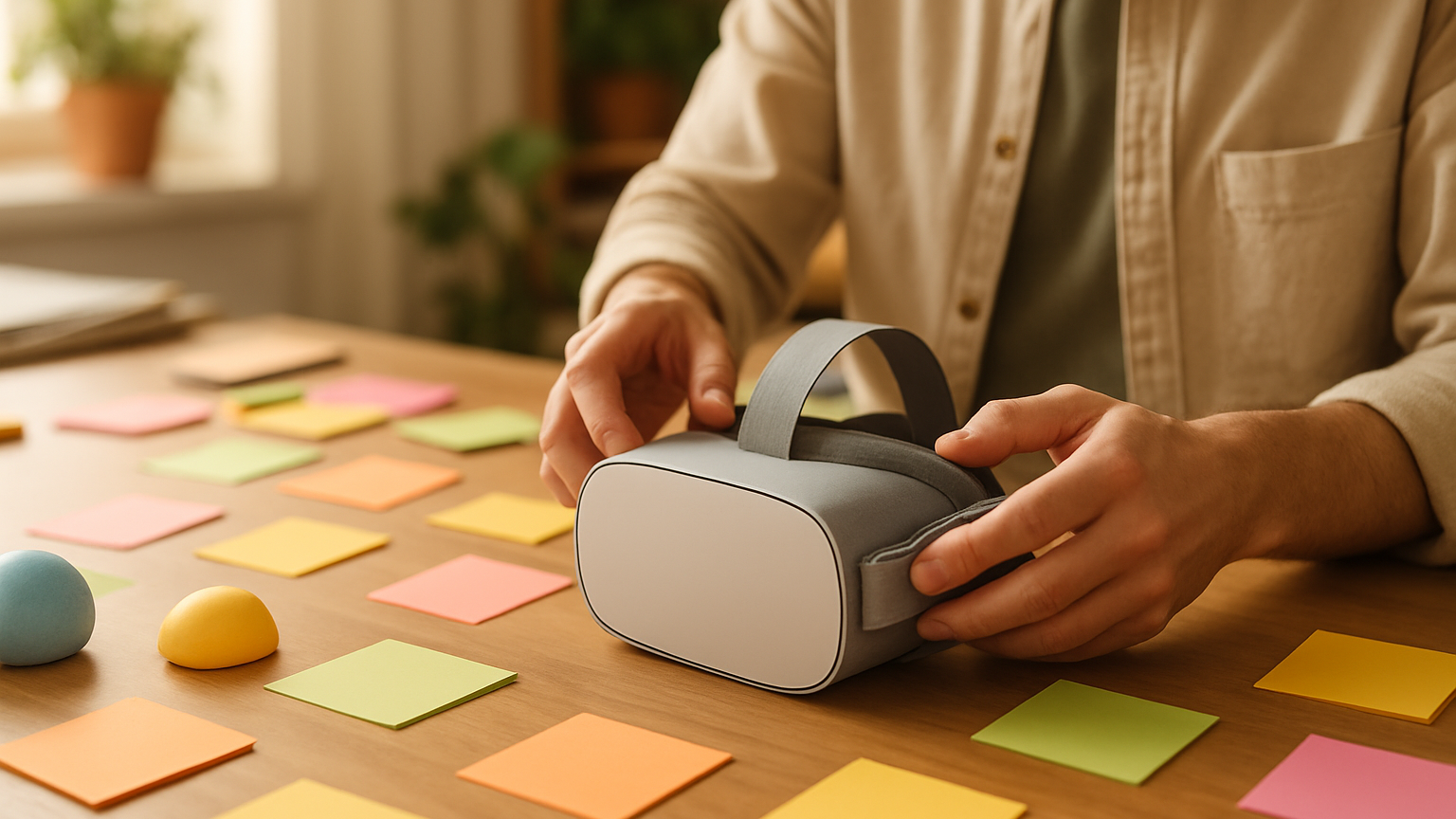
Start with people, not headsets. That’s the simple idea running through our lab when we build tools for attention, self‑regulation, and social‑emotional practice. At RTE Lab, VR design for ADHD and autism starts with everyday goals: staying on task in a noisy room, recognizing emotions in a conversation, or slowing breathing when stress spikes. We look at what helps in therapy and education already, then translate it into focused, repeatable, and therapist‑guided VR activities. Not to replace therapy, but to add a structured space where skills can be practiced safely and observed clearly. Because if it doesn’t help in a 30‑minute session with a real person, it doesn’t ship.
You’ll see this across our platforms. Focus VR supports attention, working memory, response inhibition and self‑regulation through clear tasks, guided breathing and controlled distraction. Harmony VR brings calm, sensory‑aware environments where children on the spectrum can explore rhythm, recognize emotions, and follow step‑by‑step interactions at their own pace. Both are built for specialists, clinics and research partners — with structured sessions, adjustable difficulty and progress insights. The result is a bridge between clinical intention and day‑to‑day practice. No fluff, just skills you can practice and observe.
Why Healthcare Needs Human-Centered VR Right Now
There’s a gap between engaging tech and clinically useful tech. Healthcare teams don’t need a shiny simulation; they need controlled environments where tasks are clear, sensory input is tuned, and observation is built‑in. In ADHD work, that might mean practicing attention and inhibition without unpredictable noise. In ASD support, it might mean gradual exposure to social cues and rhythms in a calm, predictable scene. Human‑centered VR aligns with how therapy and education actually run: structured goals, repeatable conditions, and the ability to pause, coach, and try again.
Human‑centered also means safety and clarity. Sessions must scale difficulty without spiking stress, and interactions have to be simple enough to learn quickly yet rich enough to be meaningful. Therapists need to guide the flow, set goals, and see progress indicators that reflect task completion — not just time spent in VR. Data helps only if it’s actionable in a session review or research pilot. That’s why we build exercises that can be repeated, adjusted, and observed like any other therapeutic technique.
And honestly, flashy graphics help nobody if the session flow breaks after minute three. We design for calm starts, clear cues, and smooth hand‑offs between activities, so coaching and regulation can happen in the moment. When teams look for innovative healthcare technologies that serve real cognitive goals, they tend to prioritize predictable sessions over spectacle — which is exactly the direction of our immersive healthcare solutions.
Our R&D Process From Concept To Clinically Mindful Prototype
We begin with outcomes: Which everyday function are we training? Attention under distraction? Breathing for self‑regulation? Emotion identification? We map needs with specialists, outline session goals, and plan what can be realistically practiced in VR. Then we design interaction patterns that keep cognitive load in check — clear affordances, minimal menus, and step‑by‑step guidance that matches the therapy plan. The north star is simple: make the next right action obvious.
Prototyping comes in tight loops. We test micro‑interactions (reach, point, look, breathe), tune sound and color for sensory comfort, and adjust timing so tasks can escalate without overwhelming. If something distracts, we cut it. We run quick therapist walkthroughs, then short sessions with observation, and fold learnings back into the build. In practice, most teams ask for repeatable sessions and structured difficulty — otherwise pilots stall after week two.
As prototypes mature, we add the scaffolding clinicians and researchers need: session planning, goal selection, and progress indicators tied to task completion. We keep observation central — what did the participant attempt, complete, or skip — and make session summaries easy to review. The intent is a clinically mindful prototype, not a demo reel. If you’re curious about how we translate needs into working software, we break down the stages inside our R&D process.
Focus VR And Harmony VR: Designed For Real-World Cognitive Goals
Two platforms, one mindset: structured, therapist‑guided practice that transfers to everyday functioning. Focus VR is built around attention, inhibition, working memory and self‑regulation. Harmony VR centers on calm, predictable, and sensory‑aware environments where children on the spectrum can practice rhythm, social cues and communication. Both support session planning, gradual difficulty, and repeatable exercises that are easy to observe and discuss.
Focus VR: Therapist-Guided Training For Attention And Self-Regulation
Focus VR creates controlled environments for ADHD‑related practice: attention and focus tasks, working memory challenges, response inhibition and task‑switching — all in clear, structured steps. Sessions are therapist‑guided with goal selection and difficulty presets, so you can scale from calm focus to controlled distraction as skills grow. Self‑regulation sits at the core: guided breathing, grounding tasks, and sensory‑controlled scenes help users return to baseline when workload increases. The aim isn’t to chase novelty; it’s to repeat targeted exercises until they stick. Explore how the features align with clinical goals on the Focus VR platform.
Harmony VR: Rhythm-Led, Sensory-Aware Activities For ASD Support
Harmony VR supports therapy and education with calm, predictable spaces where children can engage step by step. Rhythm‑based activities and virtual instruments encourage interaction without overload, while simple social scenarios introduce emotion recognition and communication cues at a comfortable pace. Sensory input can be adjusted, distractions are reduced, and progression is gradual by design. Educators and therapists plan activities, then guide practice as children respond to characters, follow visual cues and complete interactions. See how modules balance structure with engagement in the Harmony VR experience.
Progress And Observation Tools For Clinics And Research
Both platforms include practical scaffolding for teams: session summaries, progress indicators and task completion tracking that support specialist observation. Instead of vague metrics, you see what was attempted, completed, or paused — detail you can actually discuss in debrief. For pilot programs and studies, repeatable sessions and adjustable complexity help standardize conditions. This combination — guided flow plus observable outcomes — makes it easier to align VR activities with individual support pathways and research protocols.
Inclusive Design Principles We Follow
Inclusive design isn’t a checklist for us; it’s a set of choices we revisit in every prototype. We look at sensory comfort first, then clarity of interaction, then the pacing that allows practice without rushing. When a scene feels calm, instructions are simple, and the next action is obvious, users engage longer and learn more. That’s as true in a clinic as it is in a school setting.
- Begin calm, then add complexity gradually
- Keep UI minimal with clear, consistent cues
- Offer adjustable sensory input (sound, color, motion) tailored to needs
- Use therapist‑guided session flow and explicit goals
- Design repeatable tasks with controlled distractions
- Include grounding elements like guided breathing and simple resets
Trade‑offs are part of the work. A beautiful effect that adds noise is still noise, and sometimes we remove features we love because they nudge attention the wrong way. The win is a session that feels predictable and supportive, not a demo that looks impressive once.
From Insight To Impact: VR design for ADHD and autism in practice
Picture a therapist mapping a session: one attention task to warm up, one working memory activity with light distraction, then guided breathing to return to baseline. In Focus VR, that plan becomes a therapist‑guided pathway with difficulty set before you begin. As the participant progresses, the environment stays consistent and the rules don’t shift unexpectedly — which makes coaching easier and observations cleaner. Afterward, session summaries capture what was completed and where support was needed, turning the experience into material for the next visit.
Now take a classroom using Harmony VR. The educator selects a rhythm‑led activity and a simple social scene, then tunes sensory input to a calm level. Children practice responding to characters, identifying emotions and following visual cues without the noise of a real hallway or cafeteria. The pacing is gentle, the scenes are predictable, and each interaction can be repeated until it feels comfortable. Over a few sessions, small steps add up to confidence.
This approach isn’t for everyone, and that’s by design. If you need an off‑the‑shelf entertainment app, this won’t fit. If you’re looking to replace therapy, it’s not the right direction either — our tools are built to support specialist‑led work, not to stand alone. But if you want structured, repeatable practice aligned with clinical or educational goals, human‑centered VR can become a reliable part of your toolkit.
Partnering With Clinics, Schools And Research Teams
We collaborate with healthcare professionals, therapists, educational institutions and research partners to align scenarios with real‑world goals. That can mean shaping pilot protocols, creating therapist‑guided flows for specific age groups, or adapting sensory profiles for particular settings. Because sessions are repeatable and adjustable, teams can run consistent practice while collecting observations that matter.
Our role is to translate needs into working sessions you can actually run — and refine — week after week. We bring interactive prototypes, test plans and observation tools, then iterate with your team until activities feel natural in your environment. If your roadmap includes expanding into other modalities or training scenarios, you’ll find the same philosophy across our immersive healthcare solutions.
If you’re exploring VR design for ADHD and autism with your organization, the most useful first step is a focused pilot: one setting, clear goals, short cycles, and honest feedback. That’s where people‑first design proves its value — in the quiet progress of a session that just works.