
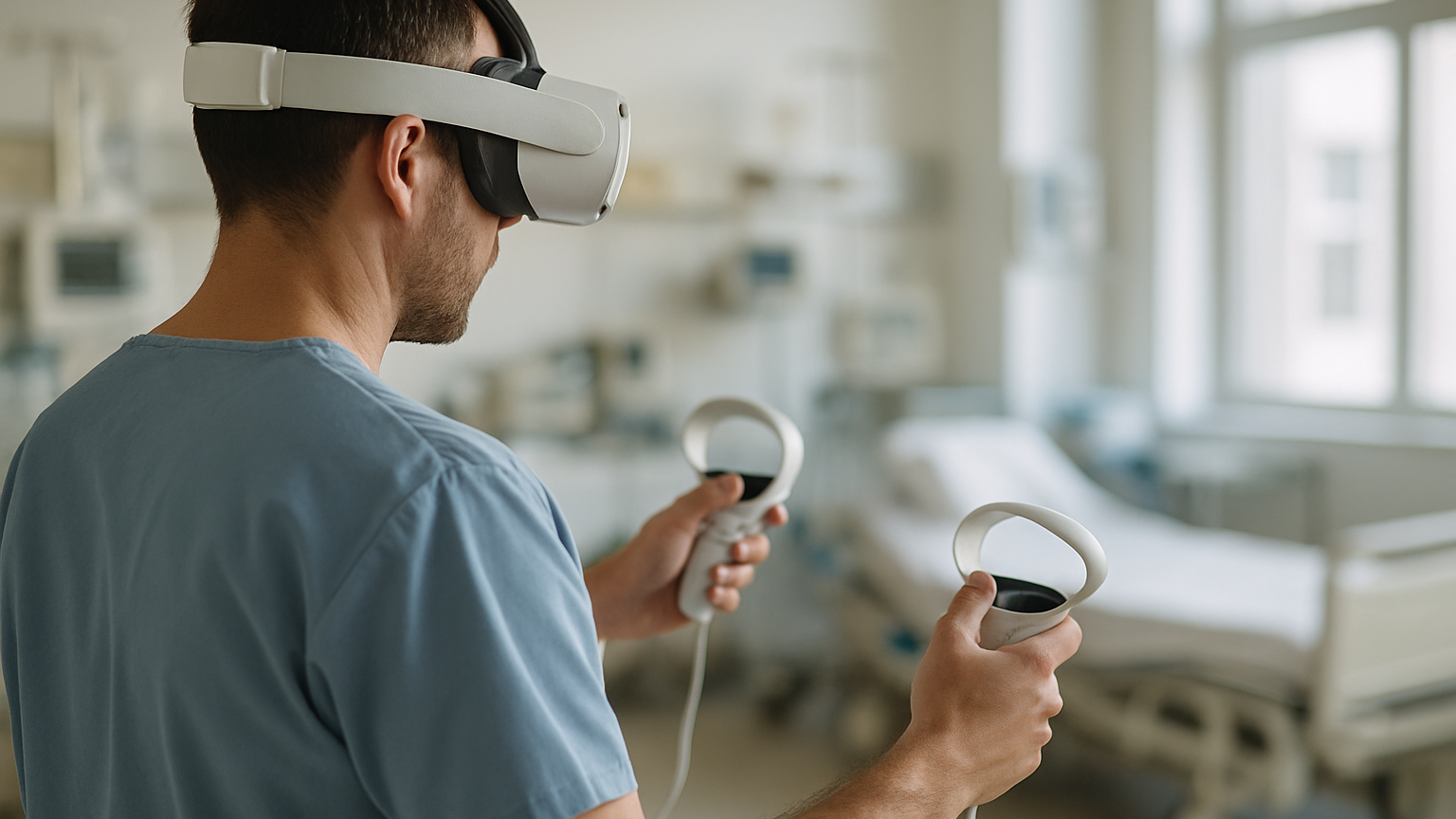
There’s the way infection prevention looks in a slide deck, and then there’s the way it unfolds when a pager goes off and three people need you at once. That’s the gap where shortcuts creep in and risk goes up. VR infection control training closes this gap by turning policy into lived practice — step by step, under pressure, in a space where mistakes become feedback instead of incidents. It’s not about flashy tech; it’s about building habits your hands remember when your head is busy. If you’re exploring the broader field of extended reality in care settings, you can see how we approach it across our immersive healthcare solutions.
Think of VR training for infection control as a rehearsal room. You can run through donning and doffing until it’s boring in the best possible way, practice hand hygiene timing when a call bell rings, and reset the room after an aerosol-generating procedure without exposing anyone. In practice, most teams notice that consistency improves fastest when scenarios match their real unit layout and workflow. And let’s be honest: nobody nails doffing perfectly the first time. The win is that the system can nudge, pause and rewind until the right sequence becomes second nature.
Why Infection Control Education Needs Immersive Practice
Most clinicians know the principles; what breaks down is execution under real conditions: noise, interruptions, time pressure. Traditional teaching focuses on recall — which poster says what — while transmission-based precautions live or die on sequencing and context. VR training for infection control flips that, making memory serve behavior rather than the other way around. When you physically move through the steps, hear the alarms, and choose what to touch next, your brain encodes the routine as an action script. That’s why immersive practice tends to stick when slide-based education washes off by the end of the shift.
There’s also the repetition factor. You can run the exact same situation multiple times with small variations — a supply out of stock, a patient coughing, a door left open — and build the ability to adapt without dropping the basics. This kind of controlled variability is hard to achieve on a busy ward and expensive in a sim center. In VR, it’s available on demand, which makes deliberate practice actually, well, deliberate. The trainee leaves with a groove, not just a note.
Is VR infection control training for every setting? Not quite. If you need to feel the exact resistance of a gown tie or test a new physical device, mannequin-based simulation is still your best friend. But when the goal is consistent sequencing, decision-making in context, and rapid refreshers that don’t consume staff and rooms, VR hits the sweet spot. It complements existing programs rather than replacing them, and it shines where repetition and behavioral fidelity matter most.
How VR infection control training fits into real workflows
Any training that lives outside the daily rhythm risks becoming trivia. The key is to map scenarios to the actual flow of a unit: from the moment a patient is flagged for isolation to the clean-down that readies the room for the next admission. VR slots into short, repeatable sessions that staff can complete between tasks, and it mirrors the cues they already use — door signs, supply carts, patient requests. The result is that learning transfers back to the ward because it was born there. That’s the difference between checking a box and changing a habit.
PPE Donning And Doffing Without Shortcuts
In VR, the full sequence becomes a lived routine: verify the indication, gather the right PPE, don in order, and enter without contaminating cuffs or mask edges. On the way out, the system tracks where your hands go, flags cross-contact, and visualizes contamination spread if you reach for your phone too soon. Immediate, visual feedback helps break the most common shortcuts — tugging at the respirator, peeling gloves in the wrong direction, touching the gown front — and replaces them with clean muscle memory. One small change many learners report is simply pausing to breathe between steps, which reduces rushed errors.
Hand Hygiene And Contact Precautions Under Time Pressure
Hand hygiene is easy when nothing else is happening; the real test comes when the monitor beeps, the patient asks for water, and a colleague calls your name. The scenario layers those distractions so you practice choosing the sink or sanitizer at the right moments and avoid touching high-risk surfaces in between. Feedback focuses on timing and coverage, not just the presence of a gel dispenser in your field of view. After a few runs, most people find their hands ‘remember’ the path — sanitize, task, sanitize — even when the environment is noisy.
Outbreak Response: Isolation Room Setup And Team Roles
When a unit shifts to outbreak protocol, the difference between order and chaos is clarity: which room becomes isolation, who runs the door, where supplies live, how waste flows out. The virtual setup lets teams rehearse signage, anteroom logic, clean-and-dirty zones, and role handoffs without moving a single cart in real life. You can practice the ‘what ifs’ — supply shortages, spill management, patient transfer — in a safe loop until the choreography clicks. It’s team learning that translates directly to a calmer, cleaner response.
Designing Scenarios With Pedagogy: From Errors To Mastery
Good VR is not just a 3D poster. It’s a lesson plan you can walk through: clear objectives, scaffolded difficulty, immediate feedback, and spaced refreshers. Early runs might include gentle prompts and visual guides; later ones fade support and introduce realistic distractions. By designing around common failure points — glove-to-sleeve contamination, missed hand hygiene moments, door drift — you help learners confront the mistakes they are likely to make on shift, then fix them in context. It’s deliberate practice disguised as routine work.
At RTE LAB, scenario creation grows from human-centered analysis: who uses it, where, with what constraints, and for which outcomes. That approach comes from projects that span therapy, rehabilitation, medical education and neurodevelopmental support, where feedback timing and clarity make the difference between engagement and overload. Insights from structured cognitive training — like our Focus VR platform and rhythm-based interactions — inform how we pace guidance, highlight attention, and reduce friction in clinical simulations. The aim is not a prettier scene; it’s a smoother path from error to mastery.
Accessibility and inclusion matter here, too. Clear language, intuitive icons, and consistent interaction patterns reduce cognitive load so learners focus on the task, not the interface. Options for seated use, adjustable heights and left/right-hand interactions expand who can participate. When the tools get out of the way, the behaviors you want to teach come forward. That’s when education sticks beyond the headset.
Measuring Competence: Analytics, Feedback And Retention
Assessment in VR infection control training is most useful when it blends three lenses: process, errors and decisions. Process looks at sequence adherence and time-on-critical steps; errors capture contamination touches or missed hygiene moments; decisions reveal whether someone chose the right precaution given symptoms and signage. Together they tell a story that goes beyond pass/fail. Trainers can spot patterns — for example, doffing degrades when a call interrupts — and coach exactly where behavior slips.
Feedback works best when it is timely and visual. Heatmaps of contamination spread, side-by-side replays of a correct vs. attempted sequence, and simple dashboards showing progress over sessions make reflection concrete. The same platform can support refreshers at planned intervals so skills don’t decay between audits. A small design note from real deployments: shorter, frequent runs tend to win over rare marathon sessions, because they fit the shift and respect attention.
For credentialing or quality improvement, aggregated analytics can highlight unit-level risk points without naming and shaming individuals. That opens a path to targeted micro-lessons instead of blanket retraining that burns time and goodwill. It also helps leaders see where environment changes — like relocating sanitizer or reorganizing supply carts — might reduce friction. When data guides both training and system design, the gains compound.
From Pilot To Scale: R&D And Academic Partnerships In XR Training
A good pilot proves the idea; a good process gets it to everyone who needs it. Our work is built around research and development that turns immersive technology into practical tools for healthcare education — from problem definition and user needs through interactive prototypes to validation in real environments. If you’re curious how that looks step by step, take a look at our R&D process. The emphasis is always the same: test with real users, iterate with domain experts, and prepare for implementation rather than a demo.
Partnerships with academic institutions and healthcare innovation programs matter because they bring robust pedagogy and evaluation to the table. Together you can align scenarios with curricula, embed valid assessment, and secure funding for broader rollouts. Grant-backed work also supports the careful studies needed to show not only satisfaction, but behavior change and impact on process measures. That evidence makes adoption easier when budgets are tight and stakeholders are rightly cautious.
Scaling has a logistics side, too: headset management, room setup, facilitator training, update cycles. Lessons from large, non-clinical deployments help here as well — coordinating multi-site content, handling version control, and designing for quick onboarding. If you want a peek at cross-industry delivery in spatial tech, explore our work with Coca-Cola; while it’s a different domain, the discipline of deployment carries over. The goal is predictable rollouts that don’t stall after the first success.
And for whom is this not the right path? If your environment cannot support basic device hygiene or you have zero access to quiet space for short sessions, VR may frustrate more than help. If your primary aim is hands-on device insertion technique or you require tactile fidelity beyond gesture-level training, stick with high-fidelity sim and task trainers. VR shines when the target is decision flow, sequence reliability and team choreography — not needle feel.
What’s Next: AI-Supported Coaching And Multi-User Drills
The near future of immersive training layers adaptive support on top of solid scenarios. AI-driven coaching can watch for recurring errors, adjust difficulty in real time, and personalize prompts without a facilitator in the room. Imagine a coach that notices you consistently brush the gown front when removing your respirator and quietly inserts a micro-lesson right then and there. The same backbone can generate varied but valid cases so staff don’t memorize a single path. It’s tutoring that respects expertise while closing specific gaps.
Team practice is also evolving. Multi-user drills let nurses, physicians, cleaners and transport staff rehearse outbreak responses together, each with their own role view and responsibilities. Communication failures surface quickly — who’s on door duty, who tracks supplies, who calls the transfer — and can be patched before the next real event. Our broader capabilities in XR and AI for healthcare, including therapeutic and engagement tools, strengthen the platform underneath these advances so education doesn’t sit in a silo. When training, analytics and teamwork come together, the habit change you want starts to feel inevitable.