
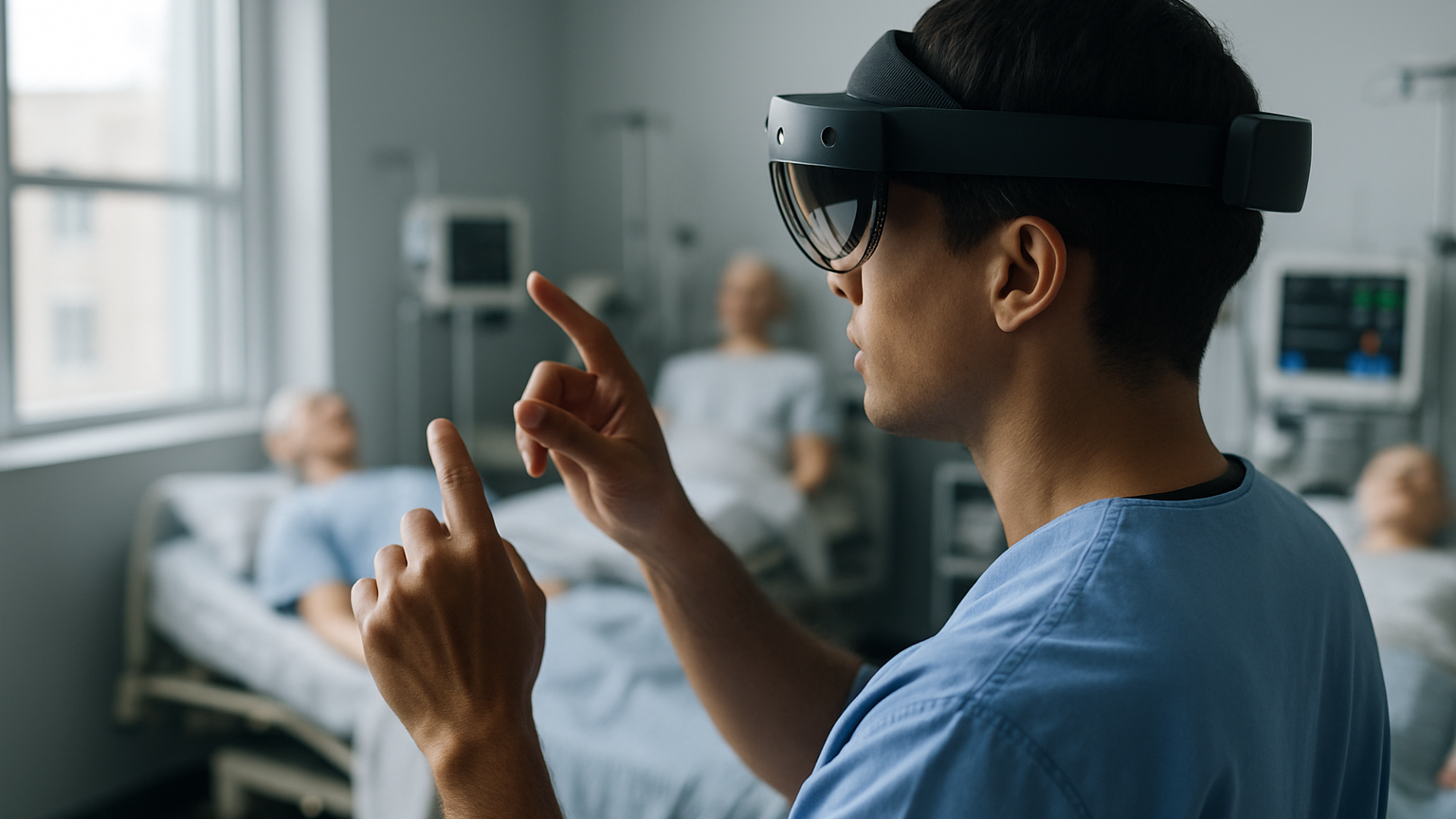
Choosing between augmented reality and virtual reality for clinical upskilling can feel like comparing an endoscopy tower to a surgical robot — both powerful, built for different jobs. If your goal is improved competence, faster onboarding, and fewer downstream errors, the question isn’t which technology is cooler, but which solves your specific training gap at scale. That’s where the real return shows up. AR vs VR in medical training is ultimately a decision about context: What tasks, in what environment, for which learners, and under what constraints. Get those four right, and the technology choice becomes obvious more often than not. Miss them, and even a beautiful demo won’t move your metrics.
This article gives you a practical buyer’s lens: when to use immersive VR to simulate rare, high‑stakes situations, and when to use AR overlays to guide real-world procedures and device workflows. We’ll walk through impact on skills, time to competence, and hidden cost drivers like content updates and device sanitation. Expect specifics, not hype — concrete examples from training, rehabilitation, and clinical communication. In practice, most clinicians will spend the first 10 minutes just getting comfortable with the headset, so design choices and onboarding matter as much as content. We’ll also call out when XR is the wrong tool entirely. Because sometimes a great PDF and a skills lab beat an expensive headset.
At RTE Lab, we blend clinical needs assessment, patient‑centered UX, and immersive build to deliver outcomes — from XR training simulations to therapy and rehabilitation apps. We design and deploy VR, AR and MR applications built for HTC, Quest, Pico and more, with both marker‑based and markerless AR depending on the environment. Our work spans 3D medical modeling, spatial audio, real‑world environment scanning, and digital twin development, all wrapped in rigorous QA for medical compliance. If you want a quick overview of what we build and where it fits in healthcare, explore our XR & AI MedTech Solutions. With that, let’s decide when each technology boosts ROI — and when it won’t.
AR vs VR in medical training: A Decision Framework For Buyers
Start with the task. If learners need full‑immersion practice for rare events — think code situations, airway crises, or complex device failures — VR creates a safe, controlled simulation with complete sensory focus. When learners need step‑by‑step guidance in their actual workspace — device setup, bedside procedures, or equipment maintenance — AR overlays instructions on the real world without removing situational awareness. Put simply, AR vs VR in medical training is less a technology choice than a fidelity choice: recreate the world when you must, or enhance the world when you can. That framing will narrow 80% of decisions quickly.
Then map constraints. Where will training occur — simulation center, ward, clinic, or at home? How many concurrent users do you expect, and how frequently will they train? What are your infection control and device cleaning policies, your Wi‑Fi or offline needs, and your IT security rules? For AR, decide early whether you’ll rely on marker‑based anchoring for precise alignment to instruments or rooms, or go markerless to reduce logistics across multiple sites. For VR, confirm whether seated versus room‑scale matters, and who supervises sessions for safety.
Finally, define the data you need. Competency frameworks, checklists with automatic scoring, heatmaps of attention, voice analytics for communication drills — all of this should integrate into your LMS or assessment flow. If you already track competencies per role, design the content and analytics to mirror that structure from day one. Also consider longevity: procedures evolve, devices get updated, and guidelines change. Plan for content modularity and an update pathway so you aren’t re‑authoring from scratch every year. The right architecture now avoids compounding rework later.
A quick reality check: this approach is not for teams looking to upload slide decks and call it transformation. If you need lightweight, asynchronous theory delivery, stick with e‑learning and videos — XR is overkill there. If procurement is seeking a one‑day wow demo for an event, that’s marketing, not training. Let’s be blunt: if you just want a flashy demo, save your budget. Invest when you have a defined skill gap, a way to measure improvement, and a plan to scale.
The Business Case: Skills Impact, Cost, And Time To Competence
Skills impact comes first. Immersive VR allows deliberate practice under pressure: compressing dozens of rare scenarios into a single afternoon so muscle memory and decision‑making improve together. AR shines when the job demands accuracy in context — correctly priming a pump, positioning a probe, or confirming a step sequence while the patient and equipment are right there. Tie both to clear checklists, objective scoring, and pass/fail thresholds per competency level. When your data shows fewer critical omissions and faster correct steps, your case for scaling is straightforward.
Cost drivers are predictable if you plan them. Content creation (3D assets, scenario logic, patient pathways, UX), device fleet (headsets or mobile AR‑capable tablets/phones), sanitation procedures, user onboarding, analytics, and ongoing updates are your big buckets. Multi‑site rollouts add device management, connectivity variance, and localized content tweaks. The flip side of cost is savings: shorter seat time, fewer in‑person workshops, less travel, and reduced risk exposure in high‑stakes procedures. Model both sides, and include a sensitivity analysis for adoption rates.
Time to competence is where AR and VR regularly outperform traditional approaches. By compressing practice into high‑repetition, feedback‑rich sessions, learners reach safe independence faster. Measure baseline proficiency, then track time to first competent performance, time to consistent performance, and decay curves over 30–90 days. If your stakeholders want to de‑risk before committing, our R&D approach helps: we design, prototype, and validate with users in short cycles, then pilot with real cohorts. You can see how we structure that in our Research & Development process.
One more financial angle: risk reduction. Reducing the probability of a never‑event or a costly readmission has outsized value even if it occurs rarely. With AR and VR in medical training aimed at high‑consequence skills, a small lift in adherence can pay back a program quickly. Conversely, if your use case is low‑impact, low‑frequency, and hard to measure, your ROI will struggle on paper even if learners enjoy the experience. Choose the battles you can quantify.
Where Each Technology Wins: XR Training Simulations, Rehabilitation, And Clinical Communication
VR wins in high‑fidelity, consequence‑rich simulations. Think airway management under time pressure, responding to a deteriorating patient, or troubleshooting device alarms when cognitive load spikes. In a headset, you control distractions, scale repetition, and add branching paths so trainees experience both success and recoverable failure. That’s incredibly hard to achieve with slides and mannequins alone. For medical device onboarding, VR can simulate malfunctions and edge cases safely, so new staff learn what “wrong” feels like before they see it on a shift.
AR wins when reality is the classroom. Overlay step‑by‑step guidance on a real infusion pump, highlight sterile zones in a procedural tray, or anchor a checklist to a ventilator so no step is missed. For ultrasound training, AR can show probe orientation, depth targets, and hand positioning right on the learner’s field of view. It helps with consistent device setup across sites and reduces reliance on a single super‑user. Because the learner never leaves the clinical environment, transfer of learning is immediate.
In rehabilitation and therapy, VR’s controlled environments and motivating feedback loops are invaluable. Graded exposure, gamified movement, and precise kinematic tracking keep patients engaged while therapists see progress over sessions. This pairs naturally with VR‑based therapy support and AI‑assisted adjustments that keep difficulty in the sweet spot. AR adds value for home‑based adherence — guiding exercises safely in a real living room while confirming correct form. Together, they create a continuum from clinic to home.
For clinical communication and soft‑skills, VR enables emotionally rich, repeatable scenarios: breaking bad news, de‑escalating conflict, or coordinating a rapid response with interprofessional roles. Add AI‑driven virtual patients and you can vary tone, symptom descriptions, and resistance in ways that keep practice authentic. AR contributes in situ — prompting key phrases, consent checkpoints, or safety confirmations during real interactions when appropriate. If your curriculum includes clinical communication simulations, a blended AR/VR approach often covers both rehearsal and real‑world reinforcement.
Implementation Blueprint: Hardware, Integration, And Compliance
Turning strategy into practice means aligning hardware, tracking, content, analytics, and governance into a tidy pipeline. The good news: the XR ecosystem is mature enough for healthcare deployment if you choose with intention. Device cleaning, identity management, remote updates, and secure data handling are now standard considerations. The build choices you make at the start — headset class, mobile AR, marker strategy, data schema — will either accelerate scale or slow it to a crawl. Get the foundations right and the rest is process.
Hardware Choices: Headsets And Mobile AR That Fit Healthcare
For VR, standalone headsets like HTC, Quest, and Pico balance performance with portability and simpler IT footprints — no tethers, faster setup, easier sanitation protocols. Consider comfort for longer sessions, controller versus hand tracking, and pass‑through or mixed reality features if you want to blend physical props. For AR, mobile devices (iOS/Android tablets and phones) are often the fastest path to scale because staff already use them and cases can be disinfected easily. Optical AR headsets can be great for hands‑free workflows, but check field of view, battery life, and fit across diverse users before committing. Whichever route you choose, plan for device management and user authentication from day one.
Tracking And Spaces: Marker-Based Versus Markerless AR
Marker‑based AR (QR codes, fiducials) gives rock‑solid alignment to devices and trays, ideal when millimeter accuracy matters or spaces change frequently. You can print, place, disinfect, and replace as needed — logistics are clear. Markerless AR uses SLAM and environment understanding to anchor content to surfaces without visible markers, reducing setup at the cost of more variability across lighting and textures. In controlled rooms, it’s wonderfully fluid; in glossy, reflective environments, you’ll want fallbacks. If you plan to mirror real locations digitally, combine environment scanning with digital twin development to speed authoring and updates.
Quality, Safety, And Compliance: Testing For Clinical Use
Healthcare demands reliability and traceability. Build with patient‑centered UX, run clinical usability testing, and put every release through rigorous QA for medical compliance. Define risk controls (motion safety, content accuracy checks, session timeouts), and document them like any clinical‑adjacent tool. Secure analytics with role‑based access, and integrate with your LMS so assessment data flows cleanly to existing records. When you treat XR like any other clinical‑grade system, governance conversations get easier and scale gets faster.
Partner With RTE Lab: Prototypes, Pilots, And Scaled Rollouts
We design, prototype, and validate immersive solutions purpose‑built for healthcare. That includes XR TRAINING SIMULATIONS, AI PATIENT ENGAGEMENT TOOLS, AI THERAPEUTIC APPLICATIONS, CUSTOM XR & AI SOLUTIONS, and UX FOR VR / AR. Our process starts with medical needs assessment and therapy or training concept design, then moves through 3D medical modeling, spatial audio, and scenario creation. We build for HTC, Quest, Pico and more, and deliver both marker‑based and markerless AR where each makes sense. It’s a single team taking you from first sketch to deployment.
If you are exploring grants or innovation funding, our multidisciplinary R&D studio is designed for early‑stage work that leads to real‑world pilots. We co‑create interactive prototypes, test with clinicians and educators, and iterate quickly until we hit defined outcomes. From there, we plan pilots with clear metrics and a scaling path that includes device management, content governance, and support. For a deeper look at how we de‑risk projects, see our Research & Development process. It keeps momentum high without skipping the clinical due diligence.
There’s honest friction too: IT security reviews, cleaning protocols, accessibility needs, and departmental scheduling can slow any rollout. We work through those with you — but it’s better to plan for them up front than be surprised later. Teams that nominate internal champions, align content to competencies, and schedule recurring updates see smoother adoption. And yes, leadership buy‑in matters; a supportive manager often does more for ROI than any single feature. No fluff, just outcomes.
Next Steps: Pilot Scope, Success Metrics, And Procurement Tips
Scope a pilot that is big enough to measure but small enough to manage. Two to three scenarios, one clear learner group, and a representative training environment usually do the trick. Aim for multiple short sessions per learner to capture repetition effects, not a single long event. Collect baseline performance before launch so improvements are defensible. And schedule content tweaks mid‑pilot — rapid iteration is part of the point.
Define success like a clinician, not a marketer. Track time to first competent attempt, error reduction on critical steps, retention at 30–90 days, and transfer to the real task where possible. Add user‑reported confidence and workload measures to round out the picture. If senior leaders care about staffing and throughput, include effects on onboarding time and preceptor load. Tie every metric back to a known operational or quality target so your ROI lands.
For procurement, focus on longevity and integration. Ensure content is modular and updatable without a full rebuild, devices can be managed securely at scale, and analytics plug into your LMS or assessment flow. Check sanitation and fit policies for inclusive use, and confirm language/localization plans if you’re multi‑site. If your IT team requires on‑prem or restricted cloud, validate that path before you author a single asset. Small checks early beat big reworks late.
Ready to map your path? We’ll help you choose where VR simulation or AR guidance creates the fastest lift, prototype only what’s needed, and pilot with clear pass/fail gates for scale. If you want a quick orientation to everything we offer — from clinical simulations to rehabilitation support — start with our XR & AI MedTech Solutions. And if your current need is simply theoretical knowledge delivery, skip XR for now and invest in great e‑learning instead. The right tool, at the right time, is how you protect ROI.