
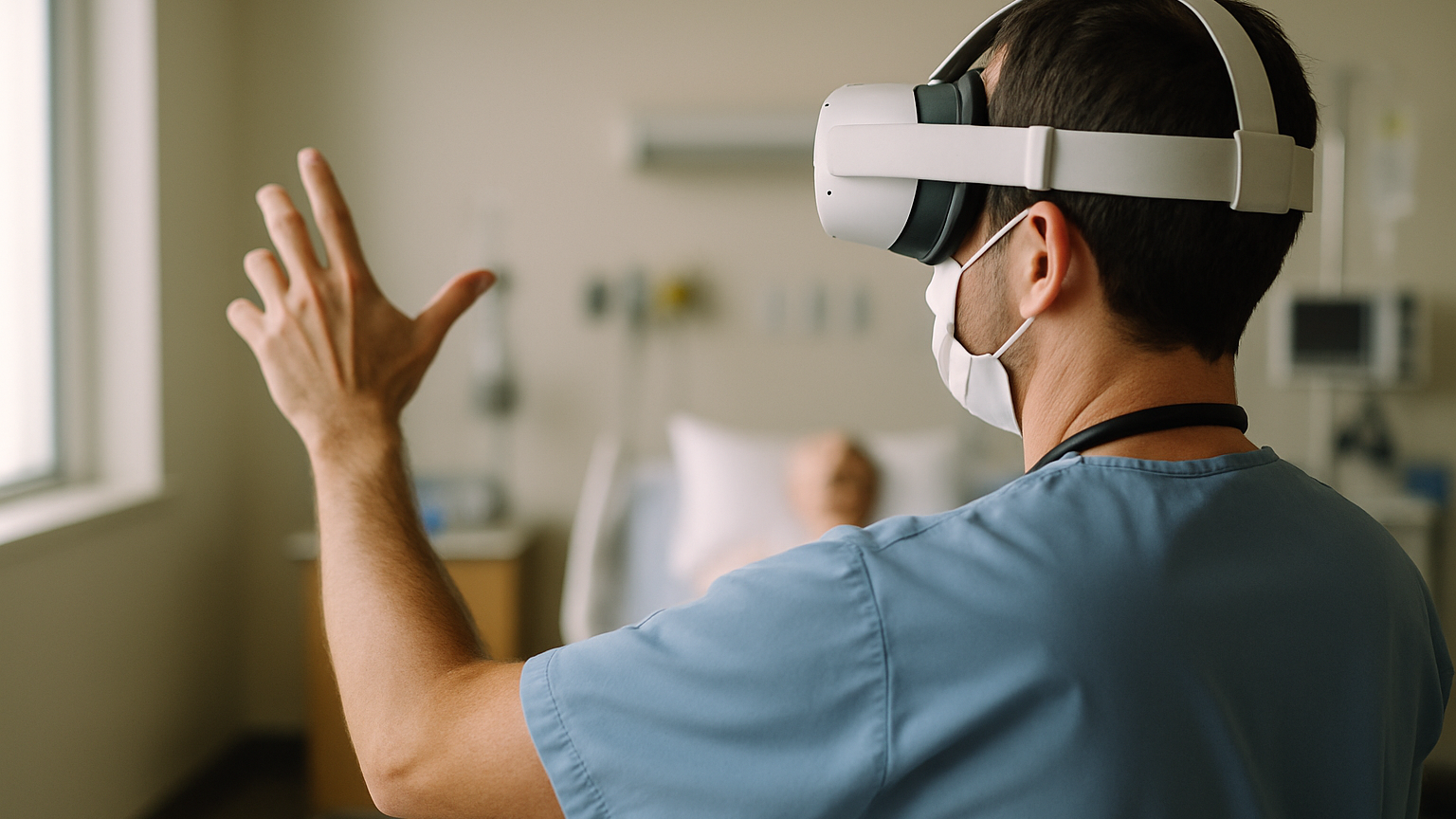
Everyone wants VR training to be “effective” — but when budget approval is on the line, effective means provable. This article focuses on VR training effectiveness in healthcare as a business case: what to measure, how to model ROI, and how to design scenarios that actually move clinical and financial needles. Finance leaders look for reductions in risk, time, and cost; clinical leads look for safer practice and stronger competence. Education teams need repeatable, scalable learning that holds up under audit. We’ll connect all three viewpoints. And we’ll do it in concrete, operational terms — not hype.
Let’s be honest: no one gets budget for “cool tech” anymore. Decision-makers approve investment when the path from training to outcomes is clear, measurable and fast to validate. In practice, you’ll need a baseline, a set of pilot objectives, and a plan to capture changes in performance — not just in-headset scores, but real-world proxies like reduced rework, safer task execution and fewer supervisor interventions. You’ll also need operational readiness: headset logistics, session flow, IT security, and debrief routines. Without that, even the best content stalls in procurement purgatory.
If you’re exploring immersive learning, it helps to map scenarios directly to high-value use cases: onboarding for new roles, rare-but-critical procedures, and communication moments that carry clinical or legal risk. That’s where immersive practice pays back faster. For organizations comparing options, end-to-end capacity — from needs assessment and patient-centered UX/UI to clinical usability testing and multi-headset deployment — removes friction across departments. If you want a quick overview of what a modern stack can look like, take a look at our XR & AI MedTech solutions. Then come back to build the case step by step.
What Decision-Makers Mean By Effective VR Training
For a CFO or COO, “effective” starts with risk, time and cost. Can training reduce avoidable errors, shorten time to competence and trim travel or backfill hours? If yes, how quickly and by how much — even in a conservative scenario. For clinical leaders, effectiveness shows up in safer decisions under pressure, clearer communication with patients and teams, and better adherence to protocols when reality gets messy. Education teams add another layer: consistency across cohorts, strong engagement, and evidence they can show to accreditation or quality committees.
There’s also durability. A program is not effective if it peaks during launch week and fades once managers get busy. Good VR curricula are built around short, repeatable scenarios with tight learning objectives and structured debriefs. They fit into real schedules without hijacking a shift. When you can re-run the same scenario six months later and see skill retention hold, that’s when training proves its worth.
Here’s a reality check many teams share: headset logistics and room scheduling beat pedagogy if you ignore them. Who books the space? How is device cleaning handled? Where do session IDs and results live to satisfy privacy and audit requirements? In practice, most training directors start by asking, “What old modules or shadowing hours can we safely replace if this works?” Tie that question to a measurable plan from day one.
And a quick note on fit: immersive simulation isn’t ideal for every topic. If your goal is policy acknowledgement or low-stakes compliance reading, VR will be overkill and a poor use of funds. It also won’t shine if subject-matter experts can’t spare any time for scenario validation — the best visuals can’t rescue misaligned content. Save VR for the moments where practice under pressure, communication nuance or psychomotor decisions truly matter.
Measuring VR training effectiveness in healthcare: What To Track
Start with a simple chain: exposure → behavior → outcomes. Inside the headset you can measure completion rates, decision paths, error types, time-on-task and assistance prompts. Pair that with pre/post knowledge checks and OSCE-style rubrics to capture behavioral change. Then link to operational outcomes you already track: rework or escalation rates, time to independent practice, patient communication quality ratings, or incident and near-miss categories. This is how you move from engagement to VR training effectiveness in healthcare that a finance team can trust.
Collection matters as much as the metric. In-headset analytics give you granular traces, but triangulate with supervisor observations and standardized checklists to ensure transfer to practice. Aim for consistent baselines: measure two to four weeks before the pilot and the same window after rollout to reduce noise. Keep cohorts comparable — role, tenure, shift pattern — so improvements don’t get lost in sampling bias.
Don’t forget retention and decay. A strong program bakes in refreshers at realistic intervals and uses shorter, targeted scenarios to maintain competence. If a skill decays faster than expected, adjust the cadence rather than rewriting the whole module. And always close the loop with debrief data: what tripped learners up, what cues helped, what changed in the next session. Those small operational tweaks usually drive the biggest aggregate gains.
Finally, visualize. A shared dashboard for clinical, education and finance stakeholders keeps everyone aligned on the same few graphs: participation, proficiency, and operational impact. Avoid vanity metrics that don’t influence decisions. The goal is to make the next budget conversation easier because your evidence is already living where leaders look.
ROI Modeling For Hospitals And Clinics: From Fewer Errors To Faster Onboarding
ROI is a modeling exercise first, a measurement exercise second. Begin with two or three scenarios tied to cost or risk hot-spots — think onboarding for new nurses, device changeovers, or high-stress communication with families. Build a conservative case and an optimistic one so stakeholders can debate ranges, not beliefs. For example, if VR reduces supervised shifts by just one day per new hire and you onboard 40 people annually, that’s 40 days of supervision hours you can redeploy. If it also trims a small percentage of avoidable errors in a targeted process, your downside case may already pay for itself.
Cost Drivers To Model: Headsets, Content, Updates, Facilitation
Account for one-time and ongoing lines. Hardware (e.g., HTC, Quest, Pico) plus sanitation and storage; content design and 3D modeling; QA for medical compliance; and updates as protocols evolve. Add facilitation time, room scheduling, and IT administration (user accounts, privacy controls, analytics). If integration with LMS or single sign-on is required, include it. Clear ownership for cleaning, charging and device rotation sounds trivial until a training day stalls — then it’s the only thing that matters.
Outcome Metrics To Quantify: Error Rates, Time To Competence, Retention
Focus on variables with financial and clinical relevance. Quantify reductions in specific error categories, shorter time to independent practice, fewer supervisor interventions, and higher pass rates on standardized assessments. Where appropriate, model reduced travel and classroom time, lower consumable use in practice labs, or improved staff retention linked to better onboarding experiences. Blend hard numbers with credible proxies — not everything shows up in a ledger on day one, but many indicators point the same way when VR learning is working.
Proof Points That Convince Finance And Clinical Leads
Leaders are swayed by evidence they can inspect: a tightly scoped pilot with clean baselines, scenario validity reviewed by clinical SMEs, and a documented debrief protocol. Show your version history and update cadence — protocols change, and your content should too. Map metrics to organizational goals and accreditation language so wins translate across committees. If you need a structured way to move from idea to validated pilot, study how human-centered teams run our research and development process — design, prototype, test, iterate — to make adoption less risky.
Designing High-Impact Scenarios: Clinical Communication, Rehab, And Soft Skills
High-impact scenarios do a few things exceptionally well: they target a single competency, simulate realistic pressure, and provide actionable feedback. For clinical communication, that could mean guiding a resident through delivering difficult news with branching dialogue and tone cues. In rehabilitation, it might focus on task-specific practice with graded difficulty and safe repetition. For team skills, recreate time-pressured coordination — who speaks when, what cues trigger escalation, how handovers actually sound in a noisy room. Spatial audio, patient-centered UX/UI, and accurate 3D models matter because they anchor decisions in context, not guesswork.
Beware over-gamification. If points and fireworks distract from clinical judgment, learners will optimize for the scoreboard instead of the standard of care. Keep scenarios short and replayable, with a clear pre-brief and debrief structure tied to your competency framework. Most teams see better outcomes when debriefs highlight decision rationales, not just right/wrong screens. That’s what helps performance transfer to the ward, clinic, or home visit.
If you need end-to-end support, look for a partner who can combine clinical simulations, rehabilitation scenarios, and medical and soft-skills training in one stack. Teams like RTE Lab deliver XR training simulations with patient-centered UX, clinical usability testing, and the ability to build for VR, AR and MR applications. The advantage is faster iteration across use cases without reinventing tooling. It’s a practical way to scale what works without fragmenting your program.
Pilot, Validate, Scale: Human-Centered R&D That De-Risks Adoption
A successful rollout looks like this: start small, pick high-signal scenarios, and validate with real users before you lock anything down. Begin with medical needs assessment and user interviews, then move to interactive prototypes and short usability sessions. Catch friction early — headset fit, control schemes, confusing prompts — before content and analytics pipelines harden. When the prototype clears clinical and educational review, pilot with a limited cohort and capture both performance and operational data.
Human-centered R&D pays off because it links technology choices to people’s constraints. Patients, clinicians, educators, caregivers — each group has different expectations and limits. Co-designing with them yields scenarios that feel relevant and usable from day one. It also makes your procurement case stronger: you’re not buying a gadget; you’re implementing a validated solution with a documented path to outcomes.
Partnerships help. Collaborating with academic, medical and institutional stakeholders can open doors to grant-funded pilots and shared evaluation frameworks. When you align your measures with quality and safety priorities, scaling ceases to be a leap of faith. It becomes a stepwise extension of what already works — across more sites, roles and scenarios.
Choosing A Partner For XR Training Simulations In Healthcare
Look for three things: healthcare fluency, end-to-end capability, and a proof mindset. Healthcare fluency shows up in scenario accuracy, clinical language, and respect for privacy and compliance. End-to-end means they can cover design, 3D medical modeling, spatial audio, development across VR/AR/MR, rigorous QA for medical compliance, and analytics. A proof mindset is visible in their insistence on baselines, pilot charters, and debrief protocols rather than promises.
Platform readiness also matters. Your partner should build for modern headsets (HTC, Quest, Pico and more) and understand marker-based and markerless AR if mixed deployments make sense. They should be comfortable working inside your security and identity stack and documenting data flows. If the team can’t explain how results feed into your LMS or reporting environment, keep looking.
This approach suits organizations that want measurable change — not just a demo day. If what you need is broad digital literacy or policy confirmation, skip immersive and invest elsewhere. But if you’re aiming for VR training effectiveness in healthcare — fewer errors in targeted workflows, faster onboarding to safe independence, stronger communication under pressure — immersive simulation is a strong bet. And if you want a single place to start the conversation, explore how we bring strategy, UX and deployment together in our XR & AI MedTech solutions.