
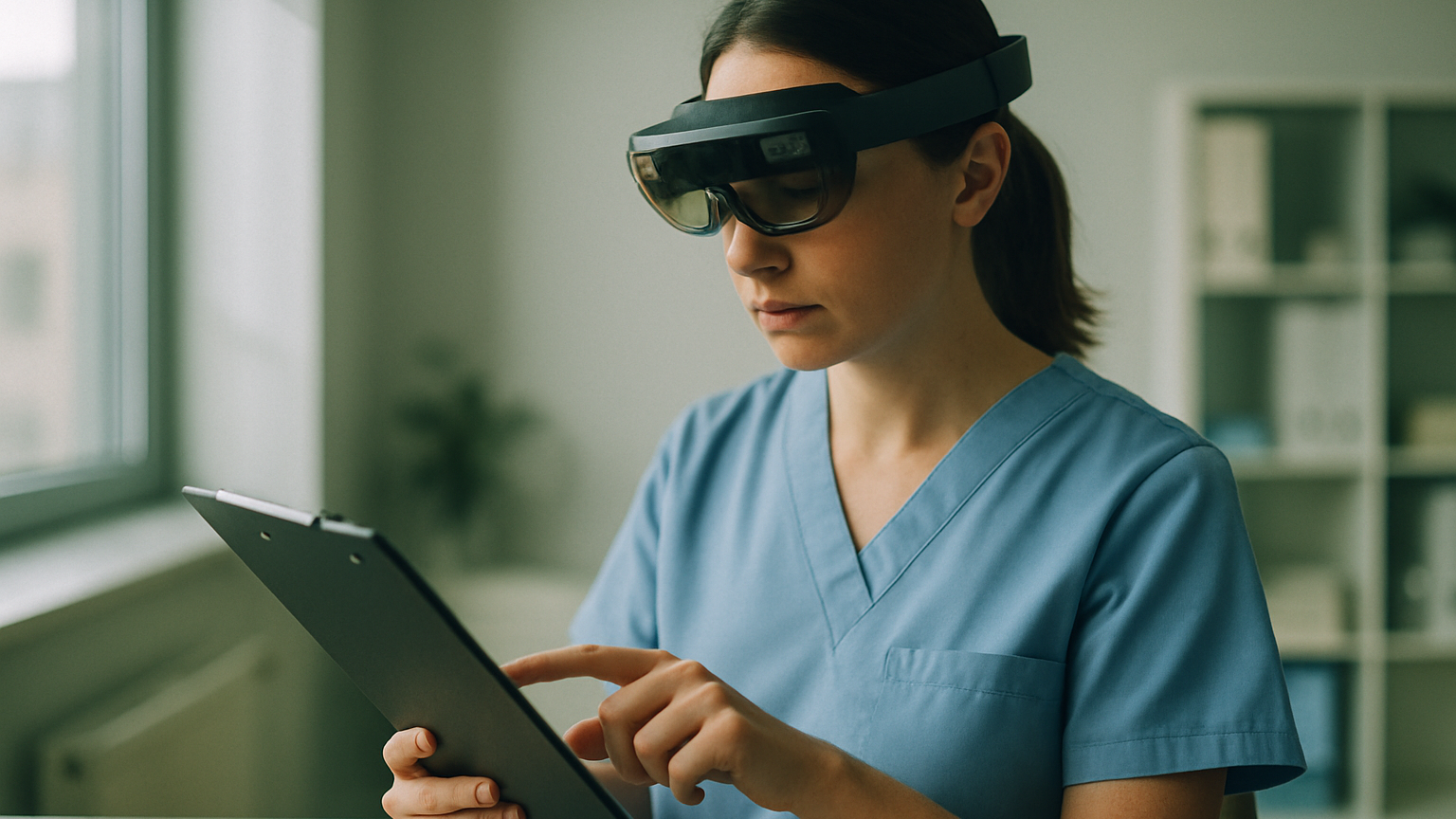
Healthcare leaders don’t need another shiny demo; they need tools that change practice, lift patient experience, and pay back. Extended Reality can do that when it’s grounded in real clinical workflows, not abstract tech. The right build lets clinicians rehearse rare events safely, patients understand their care clearly, and therapy teams reinforce protocols between sessions. When outcomes move, ROI follows—fewer errors in simulation, faster time‑to‑competency, better engagement, more sessions completed. The trick is aligning the experience with your protocols, people and data. That’s where a custom approach becomes the difference between “interesting” and indispensable.
At RTE Lab we deliver experiences built for healthcare from the ground up—training, therapy, and patient engagement that plug into your reality. If you’re evaluating pathways, devices, and content strategies, start by exploring our XR & AI MedTech solutions. We take ideas from concept to deployment with clinical usability testing and rigorous QA for medical compliance, so you can move beyond pilots and into daily use. No fluff, just outcomes. And yes, we keep ROI in view from day one, because success is more than downloads—it’s adoption, competency, and sustained value from custom healthcare XR solutions.
Why Custom Healthcare XR Solutions Outperform Generic Platforms
Generic XR platforms tend to stop at “good enough” scenarios; they can’t mirror your protocols, staffing model, or equipment constraints. A custom build encodes your procedures, roles, and escalation paths—so a sepsis scenario fires the same cues your team expects, and the debrief aligns with your checklist. Soft‑skills? We map your clinical communication standards into branching dialogues that reflect your culture, not someone else’s script. That fidelity is what translates practice time into real‑world performance. When learners recognize their own world inside the headset, usage climbs—and so do competency gains.
Performance matters too. We optimize for target environments—VR, AR, or MR—so rendering, interaction, and comfort meet clinical needs. That includes 3D medical modeling & animation for anatomical clarity, spatial audio engineering for realistic cues, and interaction patterns refined through clinical usability testing. We ship to leading devices—HTC, Quest, Pico—and tune controls to minimize cognitive load during critical tasks. For AR, we support both marker‑based and markerless approaches, depending on your space and content. The result is immersion without distraction, which is exactly what training and therapy require.
Finally, your data and reporting shouldn’t live in a silo. Custom architecture lets us capture the right performance signals, integrate with your existing analytics, and automate evidence packs for governance. Content can be modular, so you reuse core assets across departments and headsets—lowering total cost over time. If you only need a flashy demo kiosk for a trade show next week, a templated app might be faster—custom isn’t the right choice. But if you’re aiming for behavior change at scale, custom unlocks fit, adoption, and measurable impact.
Where XR Delivers Results In Healthcare: Training, Therapy, Engagement
We focus on three domains where immersive and AI‑supported solutions move the needle: training simulations, patient engagement, and therapy or rehabilitation. Our work spans XR TRAINING SIMULATIONS, AI PATIENT ENGAGEMENT TOOLS, and AI THERAPEUTIC APPLICATIONS, with tailored experiences for medical and soft‑skills training, clinical simulations, and patient care. The common thread is relevance—every module starts from a real need, not a generic template. That’s how immersive content translates into better decisions, higher adherence, and stronger satisfaction. Here’s what that looks like in practice.
XR Training Simulations For Medical And Soft Skills
High‑fidelity scenarios let teams practice rare, risky, or time‑critical events with zero harm to patients. We pair procedural steps with realistic stressors—alarms, competing priorities, team communication—then capture performance signals for debrief. Clinical communication simulations develop empathy, consent, and escalation skills using branching dialogues and immediate feedback. Multiuser options support interprofessional drills, while solo modes help new staff ramp quickly. Built for HTC, Quest, and Pico, modules travel where your learners are—simulation centers, classrooms, or on‑unit spaces—so access isn’t the bottleneck.
AI Patient Engagement Tools Across The Care Journey
Engagement rises when information is clear, timely, and personal. We map the patient journey and design AI‑supported touchpoints that explain procedures, prepare for discharge, and reinforce care plans. Think interactive pre‑visualizations that turn complex instructions into simple steps, plus guidance that adapts to patient inputs over time. Accessibility is built‑in—plain language, audio narration, and thoughtful UX so people can use it when they’re anxious or tired. The payoff is fewer avoidable calls, better preparedness, and stronger satisfaction scores.
VR-Based Therapy And Rehabilitation Scenarios
Therapy and rehab benefit from structure, repetition, and feedback—VR is strong on all three. We design VR‑based therapy support and rehabilitation scenarios that align with clinician‑defined goals and progression rules. Modules can scaffold difficulty, track session quality, and offer motivating feedback that keeps people engaged between visits. For specific populations, we create neurodevelopmental tools for ADHD and autism that clinicians can tailor to individual needs. These applications augment clinical care; they don’t replace professional judgment or protocols.
How We Build It: Human-Centered R&D From Concept To Deployment
Every build starts with understanding: medical needs assessment, therapy and training concept design, and patient journey mapping. We translate requirements into interactive pre‑visualizations so stakeholders can see, click, and course‑correct early. This is where we align on outcomes, metrics, and constraints—devices, environments, and data flows—so delivery stays predictable. When the foundation is real‑world fit, custom healthcare XR solutions become both safer to bet on and faster to adopt. It’s a straightforward formula: clarity up front, fewer surprises later.
Next comes design and validation. We craft patient‑centered UX/UI, build 3D medical modeling & animation where precision matters, and shape spatial audio so cues feel natural. Clinical usability testing happens early and often, surfacing friction before it reaches busy wards. Depending on maturity, we spin up interactive prototypes or proof‑of‑concept solutions to de‑risk new mechanics or content. Iteration here saves time and budget when production scales.
Finally, we move into solution creation and deployment: VR, AR, and MR applications for HTC, Quest, Pico, and more. For AR workflows, we support marker‑based and markerless approaches, real‑world environment scanning, and digital twin development to bring context into the experience. Each release passes rigorous QA for medical compliance and device performance, with telemetry for adoption insights. If you’d like the play‑by‑play, take a look at our research and development process—it’s designed for healthcare realities, not idealized labs.
Integration, Security, And Clinical Compliance You Can Trust
Great XR fails without smooth access and data hygiene. We design for the systems you already use, with pragmatic integration patterns and clear data contracts so the right signals reach your analytics. User flows favor single sign‑on and minimal steps to start, with offline resilience where connectivity is patchy. Device management is considered from day one—updates, permissions, and support paths are part of the plan, not an afterthought. Because busy clinicians won’t tap through ten menus. They just won’t.
Security is treated as a product feature, not a checkbox. We plan secure data flows, scoped access, and sensible retention aligned with clinical need. Auditability and operational transparency are built into dashboards, so governance teams can review usage and outcomes without digging. When third‑party tools are involved, we align on clear boundaries and responsibilities to keep your risk profile stable. The goal is simple: enable care, protect trust.
On compliance, we follow rigorous QA for medical compliance and document decisions that affect safety or usability. Clinical usability testing provides evidence that people can complete tasks effectively, efficiently, and safely. We partner with academic, medical, and institutional teams to validate content and stress‑test assumptions before wide release. That shared diligence keeps deployments smooth and audit conversations calm.
Measuring ROI: Outcomes, Adoption, And Total Cost Of Ownership
ROI in healthcare isn’t one metric; it’s a stack. For training, we instrument time‑to‑competency, scenario pass rates, and error profiles during simulation, plus retention on reassessment. For patient engagement, we track comprehension checks, completion of education modules, and post‑discharge call volume. For therapy and rehab, adherence, session quality, and goal progression show whether the experience is doing its job. In practice, most teams see adoption take off when department champions run short, focused demos in real work settings.
Total cost of ownership depends on smart reuse. We design content as modular building blocks that travel across specialties and devices, so a single asset pays back multiple times. Supporting multiple headsets—HTC, Quest, Pico—reduces lock‑in and makes procurement easier. Update pipelines keep content fresh without ground‑up rebuilds, while analytics guide which modules to invest in. The net effect is predictable spend tied to visible value.
When you combine measurable outcomes with steady adoption and thoughtful TCO, the business case writes itself. That’s the moment when budget moves from “innovation” to “operations,” and XR becomes part of how you train, engage, and treat. We keep success criteria visible, review them regularly, and adjust roadmaps so value compounds. It’s a practical path that turns pilots into programs—exactly what custom healthcare XR solutions are built to do.
Next Steps: Scoping Your Use Case And Getting A Pilot Live
The fastest route to confidence is a clearly scoped use case with measurable success criteria. We start with a concise discovery: stakeholders, workflows, content needs, devices, and data. From there, we outline outcomes and metrics, then craft an interactive prototype so you can test assumptions early. Depending on risk and novelty, we may recommend a proof‑of‑concept before full build, keeping investment aligned with evidence. This approach keeps momentum high and surprises low.
Launch planning covers content finalization, headset logistics, training for champions, and a feedback loop that captures both qualitative and quantitative signals. We instrument the pilot so adoption, competency, and satisfaction are visible in near real‑time. Short learning sessions on the ward or in rehab gyms help people cross the initial “how do I use this?” barrier quickly. Regular check‑ins turn insights into updates, keeping the pilot crisp and the story evidence‑based.
If that’s the journey you want, we’re ready to help you make it real. Start by reviewing our XR & AI MedTech solutions and aligning on a use case that can show value early. From there, we’ll tailor the plan and build with you—because custom healthcare XR solutions earn their keep when they fit your people, your protocols, and your patients.