
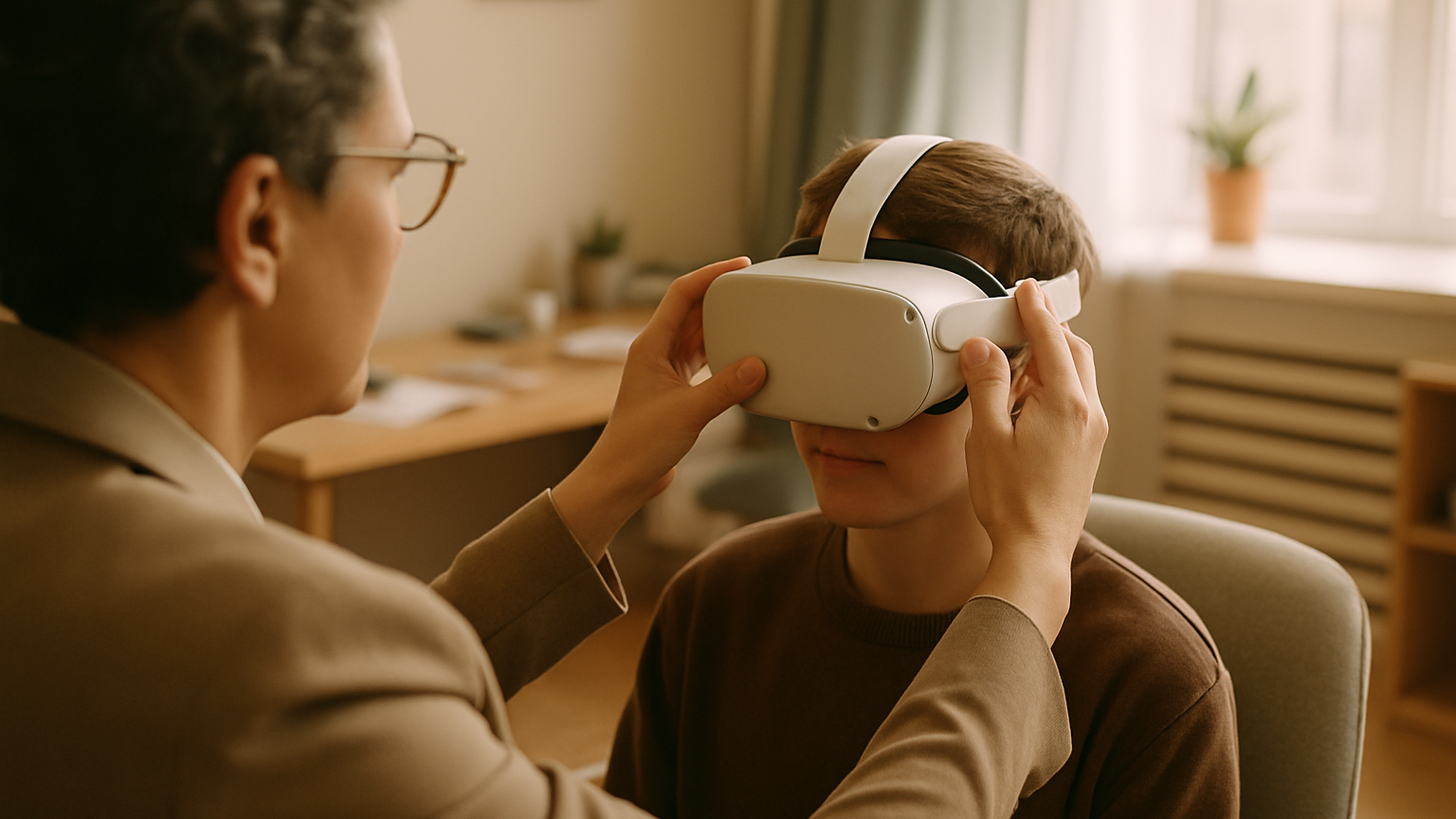
Virtual reality is no longer a conference demo or a lab curiosity; it is showing up in therapy rooms, schools and clinics. For clinicians, the real question is not whether VR is exciting, but when it is clinically useful, safe and feasible. VR therapy for ADHD and autism is moving from buzzword to workable tool because it allows structured practice, objective measurement and individualized feedback in a controlled environment. Think of it as a flexible room you can reshape in seconds: fewer distractions for attention drills, more social cues for communication practice, or a just-right sensory landscape for regulation. This article keeps an educational lens: what to look for, where it helps, where it does not, and how to bring it from idea to pilot without losing clinical rigor.
VR is not a cure, and it is not a replacement for core behavioral, educational or medical care. What it does well is create repeatable, engaging scenarios where the variables that usually derail sessions can be dialed up or down with precision. You can ask for sustained attention in a busy classroom one week, then rehearse the same task in a quiet home the next, measuring performance in both. Because VR captures rich interaction data, you can track progress beyond yes/no checklists and see patterns across sessions. The goal is practical: build skills that transfer out of the headset into the school corridor, the dinner table or the clinic waiting room.
Who is this guide for? Clinicians and program leads who want to understand the therapeutic mechanics, the safety envelope, and the development path of evidence-informed VR. We will cover why VR is gaining ground in neurodevelopmental care, how sessions run in practice, which use cases are maturing, and how to measure outcomes responsibly. We will also discuss red flags and boundaries, because constraints matter as much as capabilities. If you are considering early pilots or collaborations, you will find concrete pointers on human-centered R&D, compliance, and grant-friendly study design.
Why Is VR Gaining Ground In Neurodevelopmental Care?
Three forces are converging: control, engagement and measurement. Control means you can hold context steady while changing one variable, like background noise or number of social cues, to see how it affects attention or communication. Engagement comes from immersion and agency; when learners feel present and can interact meaningfully, practice stops feeling like homework and starts feeling like a challenge they own. Measurement is the quiet superpower: head, hand and gaze data translate into time-on-task, response latency and error patterns that inform individualized plans. This trio turns therapeutic scenarios into living laboratories without losing the human relationship at the center of care.
Another reason is ecological flexibility. Traditional computer tasks happen at a desk with a flat screen, which is fine for some goals but limited for situational coaching. VR can simulate a cafeteria line, a small-group discussion or a calm-down corner and let you scaffold skills across contexts without a field trip. You can also fade supports over time, moving from explicit prompts to subtle cues as mastery grows. This is where immersive design meets behavioral shaping in a very practical way.
Finally, the tooling has matured. Cross-headset support, spatial audio, and tested interaction patterns make deployment more predictable than even a few years ago. When combined with end-to-end thinking—user research, therapy concept design, patient-centered UX, clinical usability testing and rigorous QA—teams can deliver applications that are both engaging and clinically usable. If you are scanning the landscape of innovative healthcare technologies, explore how our XR & AI MedTech solutions structure this pipeline from needs assessment through deployment. That structure matters because it increases the odds that a prototype turns into a tool you can actually run in your setting.
How VR therapy for ADHD and autism works in practice
A typical flow starts with a brief off-headset check-in: today’s goal, mood, arousal level, and a quick plan for supports and breaks. The VR segment then runs in short, structured blocks with clear success criteria and adaptive difficulty. Clinicians often use a companion console to adjust parameters—stimulus density, distractor timing, prompt frequency—without pausing the session. After each block, there is a fast debrief to label strategies that worked and to plan the next block. The session ends with an off-headset bridge task or assignment to drive generalization.
Hardware setup is straightforward when you standardize it: clear play area, stable network if needed, seated or standing mode based on the exercise, and a simple wiping protocol for hygiene. Applications built for common devices—such as HTC, Quest or Pico—allow clinics to match their budget and infrastructure. On the software side, patient-centered UX minimizes menus and maximizes in-scenario guidance, so attention stays on the task, not on system friction. Clinical usability testing before rollout helps remove confusing steps and reduces the warm-up time per session. In practice, most clinicians find the first two sessions are acclimation; real gains tend to show up starting around session three.
Data capture during sessions should be purposeful. Time-on-target, number of successful inhibitions, working-memory sequence length, recovery time after a prompt—these metrics map to therapeutic goals rather than vanity numbers. Visualizing progress for the learner and caregiver builds buy-in and helps explain why certain strategies are being reinforced. It also supports interdisciplinary work with educators, who can align classroom accommodations with the skills being trained. When you can show a pattern—say, improved sustained attention when auditory distractions are reduced—that becomes a shared plan, not just a note in the file.
Therapeutic framing is the glue. Before the headset goes on, define what success means today in behavior terms, not just score terms. During VR, use consistent language for prompts and praise so learners connect the dots across sessions and settings. After VR, translate the strategy into a concrete, low-tech routine—like a two-step checklist or a visual cue—in the environment where it is most needed. The flashiest scenario means little if the after-action plan is vague.
Clinical Use Cases: Attention Training, Sensory Modulation, Social Skills
The strongest early use cases build on established therapeutic constructs and translate them into immersive, coachable scenarios. Rather than inventing new goals, VR lets you isolate the same building blocks you target off-screen and make them observable, repeatable and progressively harder. Attention components can be tuned by manipulating distractors in space and time. Social communication can be rehearsed with graded cues and controlled feedback. Sensory regulation can be supported through paced breathing, predictable sequences and adjustable stimulus profiles.
ADHD Focus: Inhibitory Control, Working Memory, Sustained Attention
For inhibitory control, think go/no-go or stop-signal mechanics embedded in a context that feels meaningful—catch the correct items on a moving conveyor, ignore the decoys that light up at the wrong time. Difficulty scales by shrinking response windows, adding spatial distractors, or increasing rule switches. Working memory can be trained with n-back-like sequences presented as spatial paths or auditory patterns the learner must reproduce, with immediate in-scenario coaching when errors appear. Sustained attention benefits from longer, goal-directed tasks where success depends on steady engagement despite intermittent novel events. Importantly, reinforcement is clear but not overwhelming; the point is skill acquisition, not sensory overload.
Transfer is planned, not assumed. After a block targeting inhibitory control, you might script a class-like scene where a similar rule applies, then reduce prompts to test autonomy. Metrics such as correct inhibitions per minute, latency of correct responses and error recovery time show whether the learner is relying on prompts or internalizing the rule. Caregiver handouts can echo the same wording used in VR to cue the behavior at homework time. When the same language and contingencies appear across settings, generalization has a fighting chance.
Autism Support: Social Communication And Perspective-Taking Scenarios
Social communication work often starts with clear, low-load scenes: greeting an avatar, maintaining joint attention on a shared object, or taking conversational turns with visual timing cues. Perspective-taking can be scaffolded by allowing the learner to view the scene from another character’s vantage point after a first pass, then predicting feelings or intentions with graded prompts. Scripts are helpful at first, but the system should offer a path to improvisation—fewer on-screen hints, more reliance on the learner’s reading of nonverbal signals. Safety comes from predictability: consistent rules, adjustable background noise, and a way to pause or step back when arousal rises. Over time, you can layer in naturalistic variability to build resilience without flooding the learner.
Feedback must be respectful and specific. Instead of a generic cheer, show which cue was picked up—eye gaze, gesture, tone—and why that led to a better outcome in the scene. When misunderstandings happen, brief replay with highlights can turn an error into a teachable moment. Collaboration with caregivers and educators is key so the same social rules and supports exist outside the headset. That alignment avoids the whiplash of mixed expectations between therapy and everyday life.
Cross-Cutting: Sensory Regulation And Executive Function Routines
Sensory modulation scenarios use predictable pacing, controlled visuals and spatial audio to help learners practice up- or down-regulation. Breath pacing synchronized with gentle visual expansions, or stepwise exposure to tolerable background sounds with escape valves, can build tolerance without overwhelm. Clinician controls should support quick adjustments when physiological arousal rises—dim lights, dampen audio, reduce motion—so the learner can re-enter success. Over sessions, the system can fade supports as strategies are internalized. The aim is not to eliminate sensory input, but to strengthen the learner’s self-regulation under realistic conditions.
Executive function routines benefit from sequencing tasks with clear cues and immediate feedback on planning quality. Think of a morning-get-ready routine or a homework setup ritual, broken into chunks with on-screen organizers that transition into subtle prompts. As proficiency grows, the routine shifts to off-headset checklists or visual timers that mirror the VR layout. Caregiver participation amplifies impact—when adults use the same steps and words, the routine sticks. No fluff, no gimmicks.
Measuring Outcomes, Safety And Clinical Compliance
Define outcomes at three levels: in-session, near-transfer and real-world. In-session metrics might include response latency trends, correct inhibitions, or successful turns without prompts. Near-transfer looks at similar tasks in a slightly different context—can the learner apply the rule when visuals change. Real-world measures rely on clinician observation and caregiver or educator reports aligned to the same target behaviors. When these three levels move together, you can be more confident that the gains are meaningful.
Safety protocols should be explicit and routine. Screen for motion sensitivity, photosensitivity, seizure history, severe anxiety with enclosed spaces, and significant vestibular challenges. Start with brief exposures, build predictable break points, and keep a clinician-visible arousal plan ready—reduce stimulation, switch to calming content, or pause. Hygiene, device fit and cable management (if any) are not trivial; discomfort and minor tangles can derail the best session plan. Document consent, explain what data are captured, and clarify how progress will be shared.
This won’t be a fit if the learner has uncontrolled epilepsy, strong photosensitive triggers, or consistent cybersickness unresponsive to adjustments. It is also the wrong tool if the setting cannot provide reliable supervision, a safe play area, or post-session bridging into daily routines. For learners in acute distress or with high behavioral volatility, stabilization and lower-arousal interventions should come first. VR should complement—not replace—behavioral therapy, educational supports and medical care. Clear boundaries keep enthusiasm from outrunning safety.
On the compliance side, prioritize products and pilots that show evidence of patient-centered UX, clinical usability testing and rigorous QA for medical compliance. Data handling must align with applicable privacy and security standards, and roles for clinicians, caregivers and IT should be spelled out. Training materials, quick-start guides and fallback plans reduce variability across staff and sessions. When vendors can demonstrate an end-to-end approach—from needs assessment to deployment—the burden on your team drops and fidelity goes up. Good processes are invisible to patients but palpable to clinicians.
From Prototype To Pilot: Human-Centered R&D And Grant-Funded Pilots
Moving from idea to something usable starts with people: patients, therapists, educators and caregivers. Co-design sessions surface real needs and constraints before a single line of code is written. The initial output should be an interactive prototype that tests the therapeutic mechanic, not a polished app—are the prompts clear, can difficulty adapt smoothly, do learners understand success. Short, iterative studies with observation and think-aloud feedback help refine UX and scenario design. It has to work in the real world, period.
A proof-of-concept becomes a pilot when you standardize the protocol, define outcome measures, and secure the operational basics—space, devices, cleaning, staffing and data workflows. Grant-funded pilots often value this structure, pairing well-defined aims with feasible timelines and ethically sound recruitment. Multiplatform builds—e.g., support for HTC, Quest or Pico—allow sites with different hardware to participate. Clear documentation and clinician training ensure treatment fidelity across locations. The result is data you can actually trust when deciding what to scale.
If your organization is exploring this path, look for partners who connect immersive experience design with clinical context, and who can show a throughline from research to deployment. At RTE Lab, that path is formalized in our research and development process, which spans needs assessment, therapy and training concept design, patient-centered UX/UI, interactive pre-visualizations, and rigorous QA for clinical use. Alongside VR-based therapy support, we also build XR training simulations, AI therapeutic applications, and custom XR and AI solutions that can align with neurodevelopmental goals. That breadth matters when you want therapeutic content, measurement and deployment to play nicely together. The right collaboration turns a promising idea into a pilot your clinicians can run next quarter.