
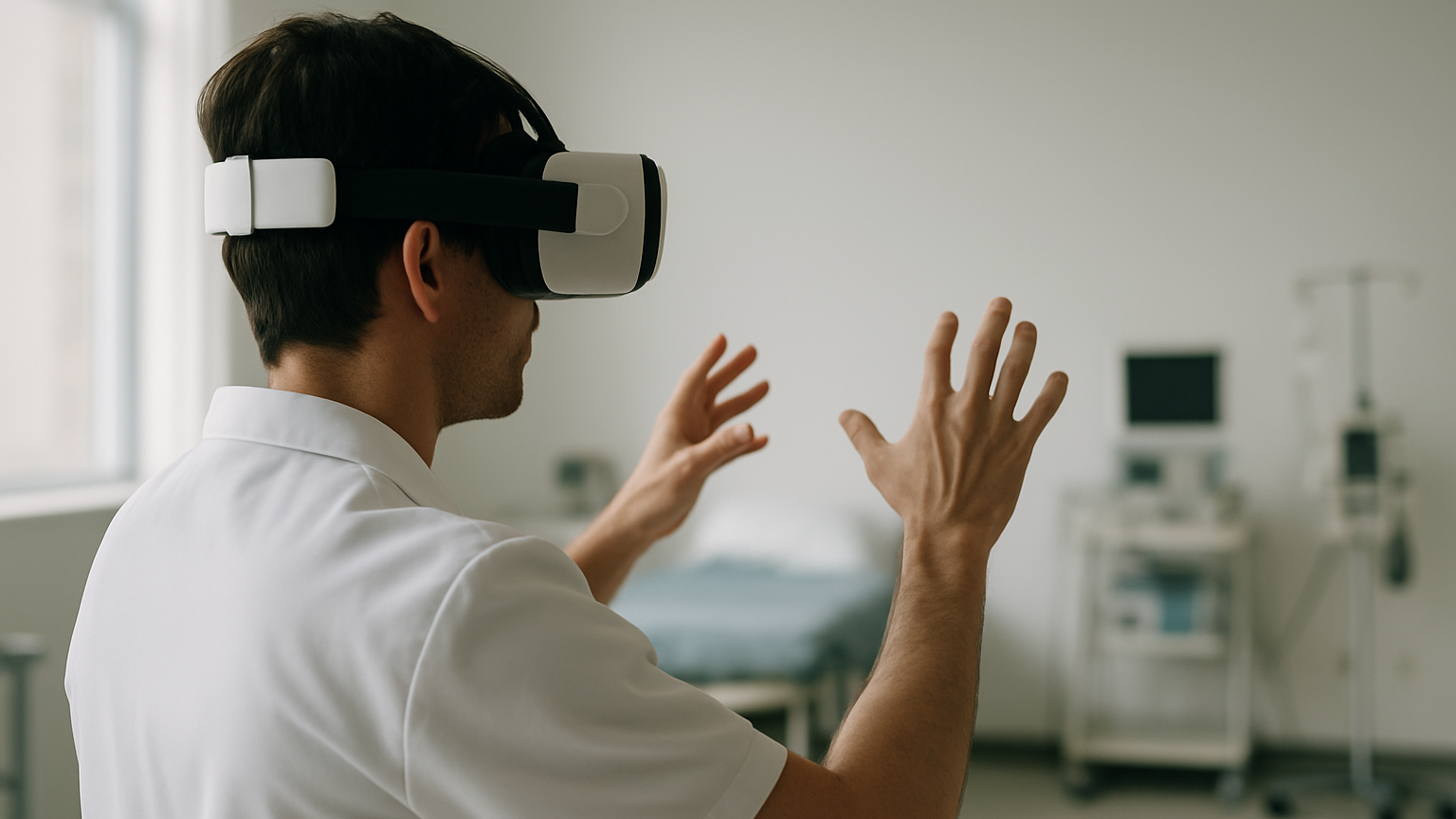
Clinical education is changing fast, but the core challenge hasn’t: learners need safe, repeatable practice that feels close to reality. That’s where a healthcare XR proof of concept comes in — not as a shiny demo, but as a way to validate whether immersive training actually moves the needle in your context. Think of it as a focused experiment: one cohort, one or two priority skills, a clear hypothesis and measurable outcomes. Instead of asking “Is VR cool?”, the question shifts to “Did residents perform the sepsis bundle faster and with fewer omissions after three short sessions?”. The best part is control: you can recreate rare events, calibrate difficulty, and capture performance data without risking patient safety.
At RTE Lab, we design, prototype and validate XR, VR and AI-supported solutions where training meets clinical reality. Our work spans therapy and rehabilitation, medical and soft-skills training, neurodevelopmental support and interactive learning — all under a human-centered R&D approach. A proof of concept sits right in the middle of that journey: it translates a learning need into an interactive prototype, then checks with users, educators and stakeholders whether it delivers value. In practice, most teams notice that once clinicians try a headset, they ask for more time-on-task — because repetition suddenly becomes engaging instead of exhausting. That energy is useful, but it needs structure, metrics and thoughtful scenario design to become evidence, not just enthusiasm.
This article walks through the essentials: why XR changes how clinicians learn, what a proof of concept should actually prove, how to design scenarios from hypothesis to headset, and how to measure outcomes responsibly. We will also cover the practical side — budgets, grants and stakeholder buy-in — so your prototype can graduate into a pilot. And yes, there is a moment when XR is not the right tool, and we will call it out. Ready to map an idea to an immersive, testable experience?
Why XR Changes How Clinicians Learn
Immersion tackles the classic gap between knowing and doing. In a headset, learners can make decisions, communicate under pressure and manipulate virtual equipment while experiencing time pressure, alarms or an anxious family member. This isn’t just visual fidelity — it is contextual fidelity: cues, constraints and consequences that mirror practice. That context makes skills stick, especially when debriefs focus on decision points and error recognition. When you can safely fail, reflect and try again three times in 20 minutes, retention accelerates.
XR also enables controlled variability. You can run the same case with different vitals, comorbidities or team compositions, which trains pattern recognition instead of rote scripts. It supports both procedural training (airway steps, sterile technique) and behavioral training (de-escalation, bias awareness, clinical communication). And because virtual patients and environments are software, you are not limited by manikin availability or standardized patient scheduling. If you are mapping possibilities, explore how these capabilities align with our XR & AI MedTech solutions — from training simulations to therapy support.
Feedback loops are different, too. Beyond checklists, you can log time-to-action, sequence of steps, medication errors avoided, and how many times a learner checked the monitor before intervening. Pair that with short, structured debriefs and you get a tight learn–test–improve cycle. In practice, a single 15-minute scenario plus a 10-minute debrief yields more targeted reflection than a one-hour lecture watched passively. That is why educators often re-balance curricula to include micro-sim sessions between longer placements.
None of this makes XR a magic bullet. It requires space, basic hygiene protocols for shared headsets, facilitator training and integration with assessment plans. Motion sensitivity can affect a small subset of learners and needs mitigation by design (stable locomotion, comfort modes, shorter sessions). And without deliberate practice and debriefing, even the most realistic simulation becomes an expensive movie. The medium is powerful, but pedagogy still leads.
What A healthcare XR proof of concept Should Prove In Training
A healthcare XR proof of concept should answer testable questions, not showcase features. Start with two or three hypotheses like: learners will complete the anaphylaxis protocol 20% faster after three sessions; or, novice nurses will reduce omission errors in central line maintenance after guided practice. Keep scope tight so signal rises above noise. Your POC should demonstrate feasibility (content, facilitation, logistics), acceptability (learner and educator buy-in) and preliminary effectiveness (early outcome movement), all aligned with curriculum goals.
Prove alignment with assessment. If your institution uses OSCEs, map scenario objectives to OSCE checklists; if you track workplace-based assessments, identify which behavioral markers the simulation could influence. Show transfer by comparing performance in a manikin lab or supervised clinical shift before and after the XR sessions. If improvement appears only in-headset, you have engagement, not learning — useful, but not enough for adoption. The POC exists to reveal that edge early.
Usability, safety and access are part of the proof. Capture task completion without instructor rescue, headset comfort, motion sensitivity responses and hygiene workflow between users. Check accessibility: clear audio, readable UI, language options, and alternative pathways for learners who cannot use headsets. Demonstrate that facilitators can run sessions without a developer in the room. If you want a blueprint for shaping those validations end-to-end, see how we structure our research and development process — from early prototypes to pilot readiness.
For whom is a POC not the right tool? If your goal is a static compliance refresher, policy updates or low-stakes knowledge checks, XR adds cost without proportional benefit. A short interactive module in your LMS or a simulation video might be the smarter path. Similarly, if you cannot allocate facilitator time or protected learner time, the pilot will underperform no matter how good the content is. XR shines when behavior change and decision-making under context are the targets.
From Hypothesis To Headset: Designing Educational Scenarios
Translate each hypothesis into a scenario that stresses the exact decision points you want to train. Start with storyboarding: patient state, room layout, equipment available, time pressure, and the prompts that will nudge or mislead learners. Assign roles — solo practitioner, nurse–physician dyad, or interprofessional team — and decide what is automated versus facilitated. Map every objective to an observable action or verbalization so scoring is unambiguous. That rigor makes debriefs faster and more focused.
Next, choose fidelity with intent. Visual realism matters less than contextual triggers like monitor alarms, a worried family member or a lab value that changes after an intervention. Design interaction to reduce motion discomfort: teleport or room-scale movement, steady camera, snap turns. Build in data capture: timestamps for key steps, error flags, path taken. A strong healthcare XR proof of concept will prioritize these essentials over cinematic details.
Finally, plan the session arc: short brief, 10–15 minute scenario, structured debrief with one or two replay moments, and a quick follow-up task. Keep scenarios modular so you can tune difficulty for novices and advanced learners without rebuilding assets. Pilot with a handful of users to catch friction points in hardware setup, voice recognition or hand tracking. Small fixes here often double the educational value.
Medical And Soft-Skills Training
Picture an acute anaphylaxis case: hives, wheeze, dropping BP, a caregiver asking questions mid-crisis. The learner must recognize severity, administer epinephrine promptly, secure the airway, start fluids, and communicate tasks to a teammate. Layer in soft-skills by having the caregiver panic if excluded, requiring the learner to delegate while maintaining rapport. Scoring ties to time-to-epinephrine, sequence adherence and clarity of closed-loop communication. This is where medical and soft-skills training reinforce each other rather than competing for attention.
RTE Lab’s training scenarios focus on usability and real-world relevance, combining clear UI with authentic cues and concise prompts. That means learners are not fighting the interface while thinking clinically, and facilitators can focus on coaching. Over iterations, we tighten the scenario “noise” to ensure critical actions are consistently triggered. The outcome is a practice space where teams can fail safely, reflect and try again — three high-quality reps in under an hour.
Clinical Communication Simulations
Communication makes or breaks care, yet is hard to rehearse under pressure. In XR, you can simulate a difficult consent conversation, an SBAR handoff to a senior, or de-escalation with an agitated patient. With AI-supported dialogue, the virtual counterpart adapts to tone, word choice and pauses, so learners must genuinely listen and respond rather than follow a script. Debriefing then focuses on empathy cues, clarity, and escalation pathways. It is realistic enough that even seasoned staff report mild adrenaline spikes — the good kind that encodes memory.
These clinical communication simulations can also surface bias and teamwork gaps. For example, a scenario may require a junior to challenge a near-miss decision respectfully, or to translate complex information to a family with limited health literacy. Success metrics go beyond “did they say the right words?” to include structure, timing and shared understanding checks. The benefit is twofold: better conversations and safer handovers.
Rehabilitation Scenarios And Therapy Support
Rehab benefits from graded, motivating practice that fits patient goals. XR enables safe balance challenges, reach-and-grasp tasks, or cognitive–motor dual tasks with tight control of difficulty and rest intervals. Therapists can track repetitions, range, accuracy and fatigue cues, then adapt on the fly. For pediatric or neurodevelopmental contexts, playful mechanics support attention and engagement without diluting clinical targets. It is therapy work, just delivered inside an environment that responds to every attempt.
Our portfolio includes VR-based therapy support and neurodevelopmental tools for ADHD and autism, where consistency and feedback are crucial. Design choices here emphasize comfort, clarity and reward schedules tuned to each user’s profile. Data stays actionable: session summaries that clinicians can interpret quickly, not dashboards that need a data scientist. When a healthcare XR proof of concept in rehab shows sustained participation and measurable gains on targeted tasks, you have a strong case for expansion.
Measuring Learning Outcomes: Evidence, Metrics And Ethics
Start with an evidence plan that mirrors your hypotheses. Combine knowledge checks (pre/post MCQs or short-answer rationales), skill performance (objective checklists, time-to-task, error counts) and behavior markers (closed-loop communication, escalation timing). Add a transfer measure: performance in a manikin lab, simulated patient encounter or supervised shift. Then, include a retention check at 30–90 days to see if gains persist. Without retention, you are likely measuring novelty, not learning.
Use headset telemetry wisely. Timestamp key actions, note sequence adherence and capture how often learners check monitoring or reassess after interventions. Keep metrics few and meaningful so facilitators can debrief quickly. Visualizing two or three indicators during debrief (for example, a simple time-to-epinephrine curve) can anchor discussions without overwhelming learners. Data is a tool for reflection, not a scoreboard.
Ethics and privacy are part of the design, not an afterthought. Obtain consent, minimize personal data, and separate learner identifiers from performance logs where possible. If you use AI-driven dialogue or analytics, document model behavior limits, failure modes and safeguards. Consider inclusion: motion sensitivity alternatives, language accessibility, and equitable access to sessions. No time, no learning.
Finally, align with institutional governance. If you plan to publish results, follow your IRB or ethics review routes early. If this is a curricular evaluation rather than research, document your evaluation framework and data handling just as carefully. The smoother these pathways are during the POC, the easier it is to scale to a pilot without stalling in approvals. It is the unglamorous work that keeps momentum real.
From Prototype To Pilot: Budget, Grants And Stakeholder Buy-In
A credible path from prototype to pilot starts with transparent budgeting. Consider hardware (headsets and hygiene accessories), software and content development, facilitator time, debrief space, and basic IT integration. Add a small buffer for iteration after the first cohort — because you will learn things you did not anticipate. Keep sessions short and high-yield to maximize throughput without sacrificing debrief quality. Document logistical wins and pain points; these matter as much as outcome graphs when leadership decides on scale.
Grants and partnerships can accelerate this step. RTE Lab’s R&D process supports grant-funded projects and collaboration with academic, medical and institutional partners, which helps align educational goals with technical feasibility from day one. Co-design with faculty and simulation leads so the pilot nests into existing curricula rather than competing with them. Bring IT and infection prevention in early to preempt deployment blockers. A small, well-supported pilot beats a large, fragile rollout every time.
Stakeholder buy-in comes from clarity. Show the exact learner groups, the scheduling model, facilitator roles, and how success will be judged at 6 and 12 weeks. Share two or three short learner quotes plus a one-page metric snapshot — enough signal, zero fluff. Be candid about trade-offs: headset cleaning time, a learning curve for facilitators, and space needs. Real life beats promises when budgets are tight.
As you evaluate next steps, map your POC results to a scale plan: expand scenarios, add cohorts, or integrate with assessment systems. If the case is strong, align procurement and curriculum timelines and schedule facilitator upskilling. If results are mixed, iterate: adjust scenarios, improve debriefs, or refine metrics before scaling. When you are ready to explore options and roadmap possibilities, review our XR & AI MedTech solutions and how they extend into clinical training, therapy support and patient engagement.